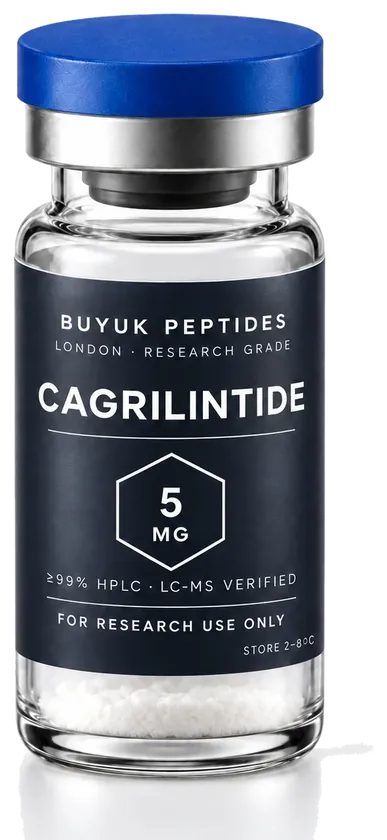
What cagrilintide is
Cagrilintide is a synthetic analogue of amylin, the 37-residue hormone that pancreatic beta cells secrete together with insulin. It was developed at Novo Nordisk under the codes AM833 and NN9838 as a long-acting amylin analogue and is the best-known member of the class sometimes described as dual amylin and calcitonin receptor agonists, since amylin receptors are formed from the calcitonin receptor in complex with receptor activity-modifying proteins.
Native human amylin is unsuitable as a research tool because it forms amyloid fibrils in solution. Cagrilintide keeps the 37-residue length and the N-terminal disulfide ring of the native hormone but carries several substitutions that reduce aggregation, together with a C20 fatty diacid attached through a linker to a lysine side-chain. The diacid binds reversibly to serum albumin and extends the half-life to about a week, which is the same design principle used for semaglutide. The CAS number is 1415456-99-3.
The published literature on the compound, with references, is collected in the monograph.
What you receive
Each vial contains cagrilintide as a white to off-white lyophilised powder, sealed with a flip-off cap over a crimped stopper, in the net quantity stated on the label: 5 mg or 10 mg. There is no carrier, mannitol or other excipient unless the batch certificate says otherwise. The batch number is printed on the label and matches the certificate in our register.
Reading the certificate for a cagrilintide batch
Purity by reversed-phase HPLC is reported as the area of the main peak against all peaks and should be above 98% for a lipidated peptide of this length, with the best lots above 99%. Identity by LC-MS is reported as the observed mass against the expected mass of the lipidated 37-residue sequence. Two features make this check informative: the fatty diacid and linker contribute several hundred daltons, so a des-lipidated impurity is easy to spot, and the disulfide bridge between the two cysteines in the N-terminal ring reduces the mass by two daltons relative to the open form, so a correct mass also supports correct folding. Net peptide content gives the milligrams of peptide in the vial after allowing for water and counter-ions.
Typical minor impurities are deletion sequences, a small proportion of the open-chain (reduced) form, and late-eluting lipid-related species. At the sub-1% level these are normal. Our guide to reading a certificate of analysis shows annotated examples, and HPLC and LC-MS explained describes the methods.
Storage and handling
Sealed vials should be kept refrigerated at 2 to 8 °C and protected from light; −20 °C is preferable for storage beyond a few months, and the lyophilised powder is stable for well over a year under those conditions. The lipidated chain is hygroscopic, so allow the vial to reach room temperature before opening. Cagrilintide is more prone than the GLP-1 analogues to self-association in solution, so published protocols dissolve it immediately before use, keep concentrations modest and avoid repeated freezing and thawing of the same aliquot. The storage and stability guide covers solvents and aliquoting.