Copper & melanocortin peptides
Copper-binding tripeptides and melanocortin receptor agonists. Every batch carries an independent certificate, with copper content reported for the copper complexes.
About this class
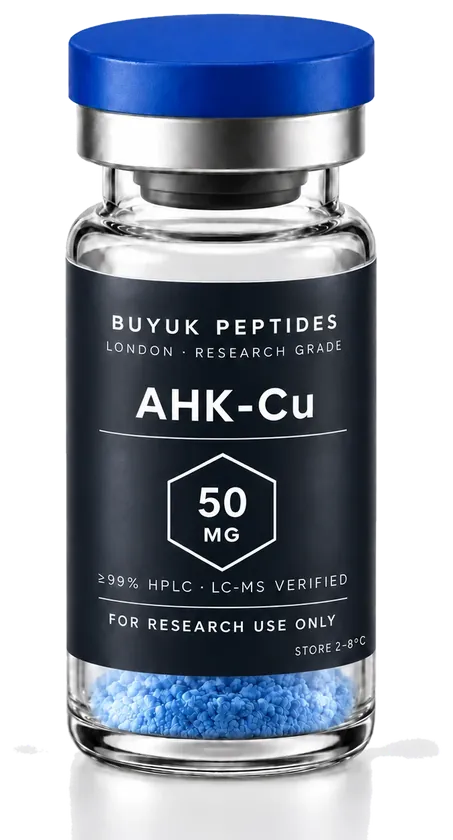
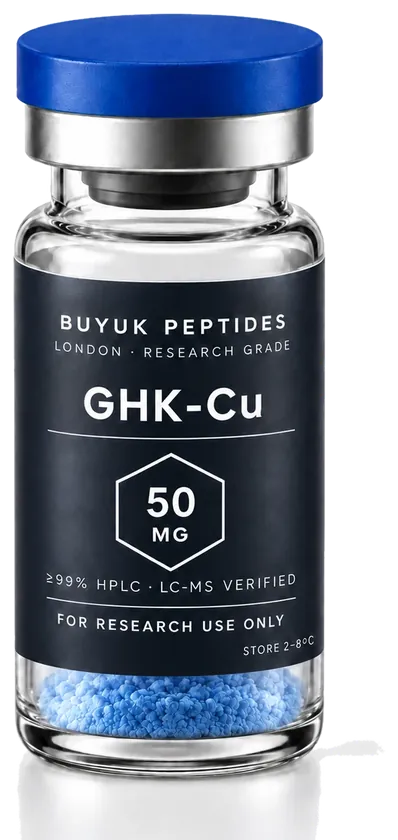
Two unrelated families share this class because both are studied in skin and pigmentation research. The copper tripeptides are tiny molecules whose activity depends on the copper ion they carry: GHK-Cu, the plasma-derived tripeptide with a large literature on fibroblasts and matrix remodelling, and AHK-Cu, its close analogue with a small literature on hair follicles. The two are compared in GHK-Cu and AHK-Cu compared.
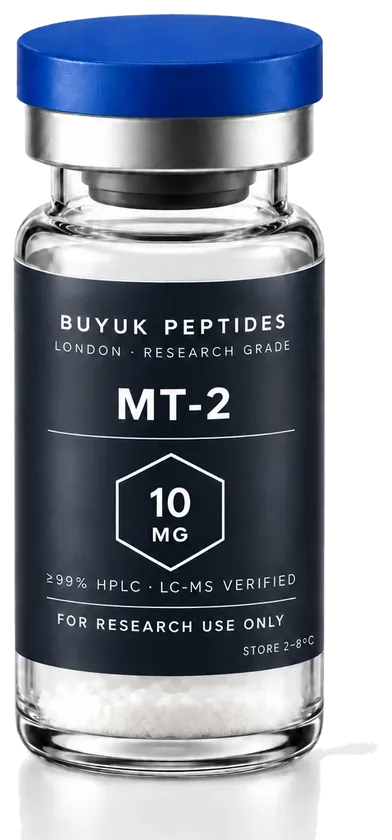
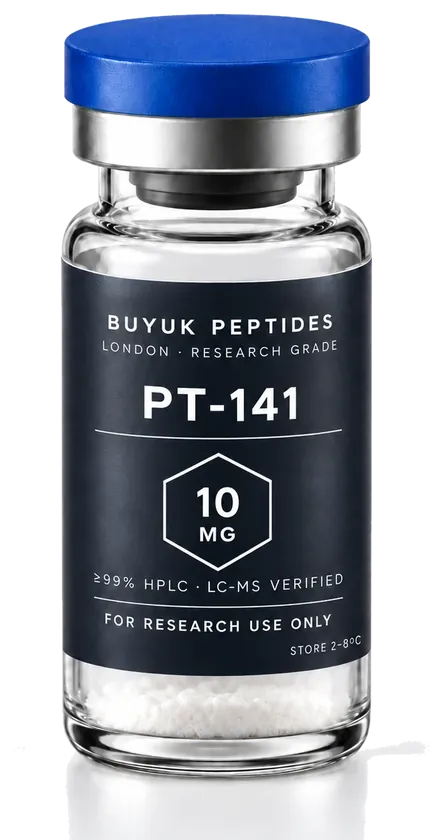
The melanocortin agonists are cyclic peptides acting at the melanocortin receptors: MT-2, a non-selective agonist, and PT-141, its derivative with a licensed counterpart in the United States. Their receptor profiles are set out in MT-2 vs PT-141.
Certificates for the copper complexes report copper content as well as peptide purity. All are supplied as research chemicals for in-vitro laboratory use only.
Questions
Why are GHK-Cu and AHK-Cu blue?
Copper(II) bound to the peptide's nitrogen atoms absorbs in the visible range. Blue confirms the material is the copper complex rather than the free tripeptide, though it does not distinguish one copper peptide from another.
How are MT-2 and PT-141 related?
PT-141 (bremelanotide) is the free-acid form of MT-2 (Melanotan II): the same cyclic sequence without the C-terminal amide, and reported as one of its metabolites. Both are cyclic melanocortin receptor agonists, with different receptor selectivity. The comparison guide covers the details.