Free Royal Mail Tracked 24 on every order · Same-day dispatch before 3pmIndependent HPLC and LC-MS certificate on every batch
BuyUK PeptidesResearch peptides, London
Home/Catalogue/GHRH, GHS & IGF analogues/Hexarelin
GHRH, GHS & IGF analogues · 6 amino acids · CAS 140703-51-1

Hexarelin

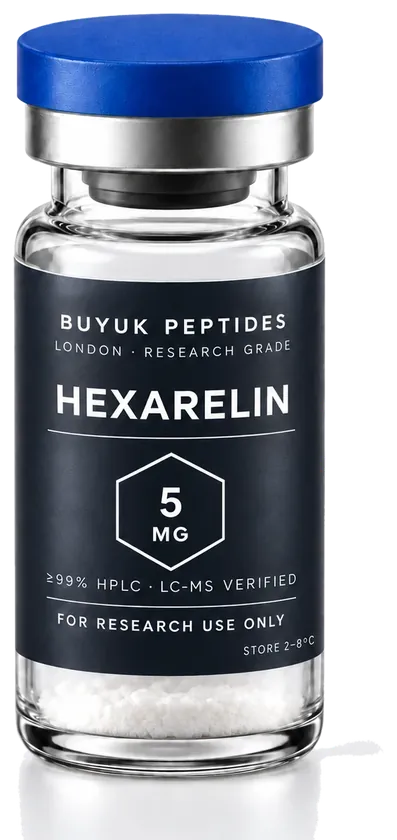
A synthetic six-residue growth hormone secretagogue of the GHRP family, supplied as a lyophilised research powder in 5 mg vials with an independent HPLC and LC-MS certificate published for every batch.

Vial size
£25.00BK-HEXA-5 · In stock, dispatched today before 3pm

Certificate for this size is being published and will be linked here before dispatch.

Certificate of analysisAwaiting
Hexarelin

No batch of this vial has been released yet. A batch is released only once its independent report is in and published here. Until then it cannot be ordered.

About Hexarelin

Written for laboratory researchers from the published literature. Not medical advice; nothing on this page describes use in humans or animals.

What hexarelin is

Hexarelin is a synthetic hexapeptide with the sequence His-D-2-methyl-Trp-Ala-Trp-D-Phe-Lys-NH2. It belongs to the growth hormone releasing peptide (GHRP) family, a series of short peptides developed from the late 1970s onwards that act at the ghrelin receptor, GHS-R1a, rather than at the GHRH receptor. Hexarelin was described in the early 1990s by Deghenghi and colleagues as an analogue of the earlier GHRP-6, in which the second residue is replaced by 2-methyl-D-tryptophan to improve stability.

The receptor through which the GHRPs act, GHS-R1a, was cloned in 1996 and its endogenous ligand ghrelin identified three years later, so hexarelin is now described as a ghrelin receptor agonist. The published literature also reports that it binds the scavenger receptor CD36. The two D-amino acids and the methylated tryptophan make the chain resistant to proteolysis. The C-terminus is amidated. The average molecular weight is approximately 887 g/mol and the CAS number is 140703-51-1.

The published literature on the compound, with references, is collected in the monograph.

What you receive

Each vial contains hexarelin as a white to off-white lyophilised powder, sealed with a flip-off cap over a crimped stopper, in the net quantity stated on the label: 5 mg. There is no carrier, mannitol or other excipient unless the batch certificate says otherwise. The batch number is printed on the label and matches the certificate in our register.

Reading the certificate for a hexarelin batch

Three results matter. Purity by reversed-phase HPLC is reported as the area of the main peak against all peaks and should be above 99% for a six-residue peptide, since a short synthesis has few opportunities for deletion sequences. Identity by LC-MS is reported as the observed mass against the expected mass of about 887 Da; a match within instrument tolerance confirms the sequence including the methylated tryptophan, which distinguishes hexarelin from GHRP-6 on a mass spectrum. Net peptide content gives the milligrams of peptide actually in the vial, as distinct from the nominal fill.

The impurity to watch for is oxidation of the tryptophan residues, which appears as small peaks at plus 16 and plus 32 Da. These should be well below 1% in a fresh lyophilised batch. Our guide to reading a certificate of analysis walks through annotated examples.

Storage and handling

Sealed vials should be kept refrigerated at 2 to 8 °C and protected from light; the tryptophan residues make hexarelin more light-sensitive than most short peptides, so the dark is important. For storage beyond a few months, −20 °C is preferable. The lyophilised powder is stable for well over a year under those conditions. Allow the vial to reach room temperature before opening so that condensation does not form on the powder. Hexarelin dissolves readily in water or dilute buffer. Reconstituted solutions should be prepared fresh or aliquoted and frozen, and kept out of light; the storage and stability guide covers solvents, concentrations and freeze-thaw behaviour.

Specification

Reference values pending verification against the batch certificate.

CAS number
140703-51-1
Molecular formula
C47H58N12O6
Molecular weight
887 g/mol
Sequence
His-D-2-MeTrp-Ala-Trp-D-Phe-Lys-NH2
Appearance
White to off-white lyophilised powder
Purity
≥99% by RP-HPLC, per batch certificate
Net content
5 mg
Storage, sealed
2–8 °C short term; −20 °C or below long term; protect from light; avoid freeze–thaw cycles
Storage, reconstituted
2–8 °C; use within the period stated in the compound monograph
Research use
In-vitro laboratory research only

Questions about Hexarelin

How does hexarelin differ from ipamorelin?

Both act at the ghrelin receptor GHS-R1a, but hexarelin is a six-residue member of the older GHRP series, built around a tryptophan and a 2-methyltryptophan, whereas ipamorelin is a five-residue peptide from a later Novo Nordisk programme. The published literature on hexarelin is notable for reporting a second binding partner, the scavenger receptor CD36, which ipamorelin is not described as sharing.

What does the certificate for a hexarelin batch show?

It reports purity by reversed-phase HPLC as area-percent of the main peak, identity by LC-MS as the observed mass against the expected mass of about 887 Da, and the net peptide content per vial. The two tryptophan-type residues give the molecule a strong absorbance at 280 nm, which the laboratory can use as a second check on net content. The signed PDF is linked from the batch page.

Why is hexarelin offered only in 5 mg vials?

At a molecular weight of about 887 g/mol, 5 mg is roughly 5.6 micromoles, which is far more than a series of receptor-binding or calcium-flux assays consumes. Hexarelin is usually ordered as a comparator alongside other secretagogues rather than as the main consumable of a project, and a single size keeps every vial on a current batch with a published certificate.

What is the GHRP family?

The growth hormone releasing peptides are a series of short synthetic peptides, developed from the 1970s onwards, that stimulate growth hormone release through a receptor distinct from the GHRH receptor. That receptor was cloned in 1996 and its natural ligand, ghrelin, identified in 1999. Hexarelin is one of the most studied members of the series and is often used as the reference GHRP in receptor work.

What is in the vial?

Hexarelin as a white to off-white lyophilised powder, sealed under nitrogen, in the net quantity stated on the label. No carrier, no excipient unless the certificate says otherwise.

Which batch will I receive?

None yet. A size is released for sale only once its batch report is published here.

How is purity measured?

By reversed-phase HPLC at an independent laboratory, reported as the area of the main peak against all peaks. Identity is confirmed by LC-MS against the expected mass.

How should the sealed vial be stored?

2–8 °C short term; −20 °C or below long term; protect from light; avoid freeze–thaw cycles

When is my order dispatched?

Same day for orders placed before 3pm, Monday to Saturday, by Royal Mail Tracked 24. Delivery is free.

Who may buy?

Researchers and institutions aged 18 or over, for in-vitro laboratory use under our terms. Nothing we sell is for human or veterinary use.

Chat on WhatsApp