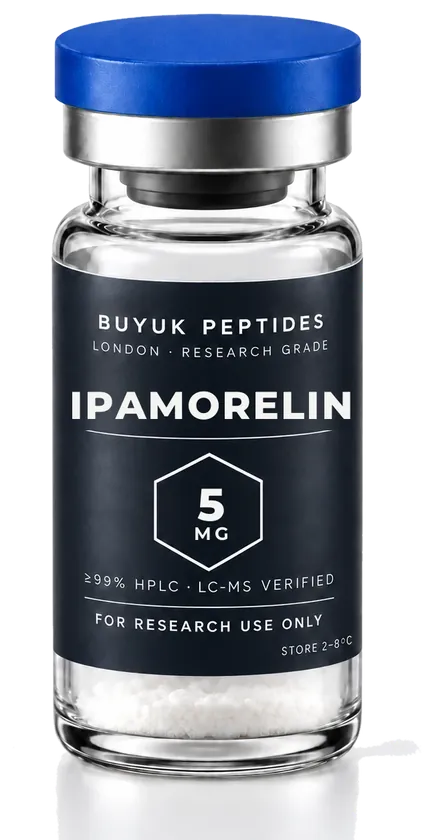
What ipamorelin is
Ipamorelin is a synthetic pentapeptide with the sequence Aib-His-D-2-Nal-D-Phe-Lys-NH2, where Aib is 2-aminoisobutyric acid and D-2-Nal is D-3-(2-naphthyl)alanine. It was developed at Novo Nordisk in the 1990s as part of a programme on small ghrelin-receptor ligands, and it was characterised in a 1998 publication in the European Journal of Endocrinology. It acts as an agonist at the growth hormone secretagogue receptor, GHS-R1a, which was later identified as the receptor for the endogenous hormone ghrelin.
The non-natural residues are what distinguish it from a simple peptide fragment. The two D-amino acids and the Aib residue make the chain resistant to proteolysis, and the naphthylalanine side-chain provides the hydrophobic contact that the receptor requires. The C-terminus is amidated. The average molecular weight is approximately 712 g/mol and the CAS number is 170851-70-4.
The published literature on the compound, with references, is collected in the monograph.
What you receive
Each vial contains ipamorelin as a white lyophilised powder, sealed with a flip-off cap over a crimped stopper, in the net quantity stated on the label: 5 or 10 mg. There is no carrier, mannitol or other excipient unless the batch certificate says otherwise. The batch number is printed on the label and matches the certificate in our register.
The same batch is supplied to every customer who orders that size while it is shipping, so the figures on the certificate are the figures for your vial. When a batch sells out, the next one is tested and published before the size is listed again.
Reading the certificate for an ipamorelin batch
Three results matter. Purity by reversed-phase HPLC is reported as the area of the main peak against all peaks and should be above 99% for a short peptide like this one, since a five-residue synthesis has few opportunities for deletion sequences. Identity by LC-MS is reported as the observed mass against the expected mass of about 712 Da; the singly protonated ion at roughly 713 is normally the base peak, and a match within instrument tolerance confirms the sequence including the naphthylalanine. Net peptide content gives the milligrams of peptide actually in the vial, as distinct from the nominal fill, which matters because lyophilised short peptides often carry a few percent of water and counter-ion by weight.
Typical minor impurities are the trifluoroacetate salt form, which is reported separately where the laboratory measures it, and traces of the des-amido acid form at the C-terminus. Our guide to reading a certificate of analysis walks through annotated examples.
Storage and handling
Sealed vials should be kept refrigerated at 2 to 8 °C and protected from light; for storage beyond a few months, −20 °C is preferable. The lyophilised powder is stable for well over a year under those conditions and is only mildly hygroscopic, but it is still sensible to allow the vial to reach room temperature before opening so that condensation does not form on the powder. Ipamorelin dissolves readily in water or dilute buffer. Reconstituted solutions should be prepared fresh or aliquoted and frozen; the storage and stability guide covers solvents, concentrations and freeze-thaw behaviour.