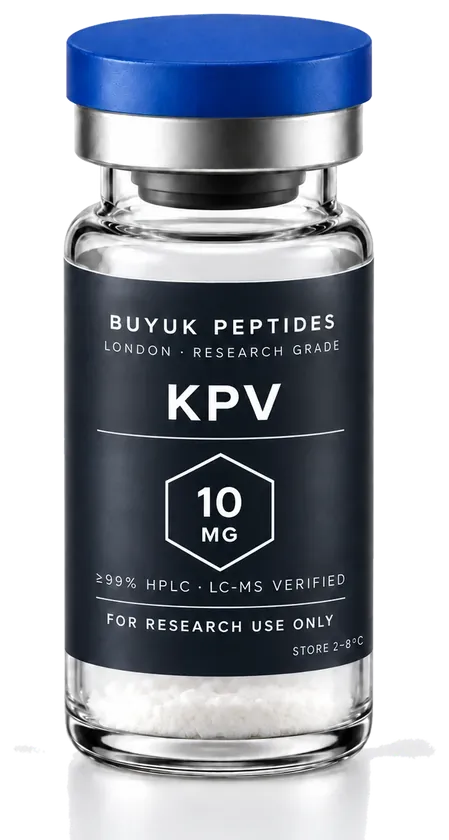
What KPV is
KPV is the tripeptide lysyl-prolyl-valine, the three C-terminal residues (positions 11 to 13) of α-melanocyte-stimulating hormone. α-MSH is a thirteen-residue hormone cleaved from pro-opiomelanocortin, and its activity at the melanocortin receptors depends on the central His-Phe-Arg-Trp sequence, which KPV does not contain. The fragment has no measurable affinity for the melanocortin receptors, which is why it is studied separately from the parent hormone.
As a molecule KPV is simple: three natural L-amino acids, a free amino terminus and a free carboxylate, with a molecular weight of approximately 342 g/mol. It is supplied as the free peptide, usually as an acetate salt. No CAS number is printed on the label or certificate for the reasons given in the questions below. KPV belongs to the neuropeptides and other class and is one of the four components of the KLOW blend.
The published literature on the compound, with references, is collected in the monograph.
What you receive
Each vial contains KPV as a white lyophilised powder, sealed with a flip-off cap over a crimped stopper, in the net quantity stated on the label: 10 mg. There is no carrier, mannitol or other excipient unless the batch certificate says otherwise. The batch number is printed on the label and matches the certificate in our register.
Reading the certificate for a KPV batch
Three results matter. Purity by reversed-phase HPLC is reported as the area of the main peak against all peaks, and for a tripeptide it should be above 99%, since there is little scope for deletion or truncation products in a three-step synthesis. Identity by LC-MS is a single protonated ion at about 343, with the expected mass of the neutral peptide about 342 Da; there is no multiply charged series to interpret. Net content gives the milligrams of peptide actually present, as distinct from the nominal fill, and for a peptide sold as an acetate salt it is worth checking whether the figure is net peptide or gross salt weight.
The one impurity to expect is the Lys-Pro diketopiperazine, a cyclic by-product that any peptide with proline in the second position forms readily, which shows as a small early peak. Our guide to reading a certificate of analysis walks through annotated examples, and HPLC and LC-MS explained covers the methods.
Storage and handling
Sealed vials should be kept refrigerated at 2 to 8 °C and protected from light; −20 °C is preferable beyond a few months. Short peptides with a free amino terminus are hygroscopic, and KPV will absorb moisture if a cold vial is opened, so allow it to reach room temperature first and reseal promptly. The peptide has no oxidisable residues and is stable for well over a year as a dry powder. It dissolves readily in water, buffer or dilute acetic acid; the storage and stability guide covers solvents, concentrations and freeze-thaw behaviour.