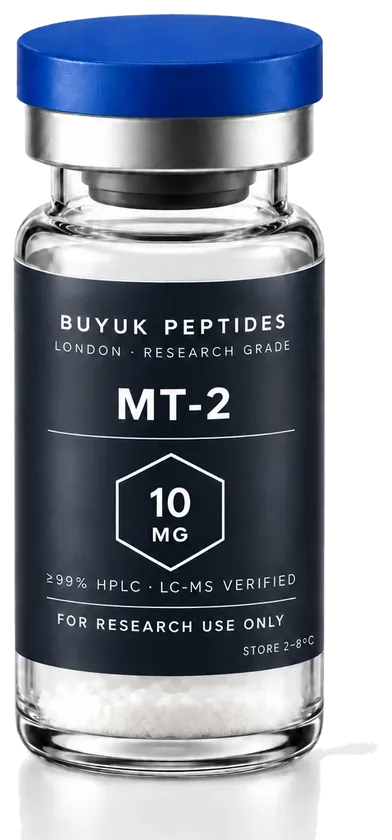
What MT-2 is
MT-2, also written MT2 or MT-II and known as Melanotan II or Melanotan 2 (the "MT2 peptide"), is a synthetic cyclic heptapeptide derived from the sequence of α-melanocyte-stimulating hormone (α-MSH), the thirteen-residue hormone cleaved from pro-opiomelanocortin. It was designed in the 1980s by Victor Hruby's group at the University of Arizona, working with Mac Hadley, in a programme to make conformationally constrained and enzymatically stable analogues of the natural hormone. The sequence is Ac-Nle-cyclo[Asp-His-D-Phe-Arg-Trp-Lys]-NH2: the His-Phe-Arg-Trp pharmacophore of α-MSH is kept, phenylalanine is replaced by its D-enantiomer, methionine is replaced by norleucine, and a lactam bridge between the side-chains of aspartate and lysine closes the ring.
Those changes give MT-2 far higher receptor potency and a much longer lifetime in solution than α-MSH, which is degraded within minutes. It is a non-selective agonist at the melanocortin receptors MC1R, MC3R, MC4R and MC5R, with negligible activity at MC2R, the ACTH receptor. The molecular weight is approximately 1,024 g/mol and the CAS number is 121062-08-6. It is the parent compound of PT-141, its C-terminal carboxylic acid metabolite, and sits in the copper and melanocortin peptides class.
The published literature on the compound, with references, is collected in the monograph.
What you receive
Each vial contains Melanotan 2 (MT2) as a white lyophilised powder, sealed with a flip-off cap over a crimped stopper, in the net quantity stated on the label: 10 mg. The batch number is printed on the label and matches the certificate in our register.
Reading the certificate for an MT-2 batch
Purity by reversed-phase HPLC is reported as the area of the main peak against all peaks and should be above 99%. Identity by LC-MS is reported as the observed mass against the expected mass of about 1,024 Da; the molecule carries two basic residues, so it ionises readily and is usually seen as singly and doubly charged ions. A match confirms both that the sequence is correct and that the lactam ring has closed, since the uncyclised precursor is 18 Da heavier. Net content gives the milligrams of peptide actually present, as distinct from the nominal fill.
The impurities worth knowing about are the linear uncyclised peptide, the des-acetyl form (42 Da lighter) and oxidation of the tryptophan (16 Da heavier). A trace of the free acid, which is PT-141, can appear if the amide has hydrolysed. Our guide to reading a certificate of analysis walks through annotated examples, and HPLC and LC-MS explained covers the methods themselves.
Storage and handling
Sealed vials should be kept refrigerated at 2 to 8 °C and protected from light; −20 °C is preferable beyond a few months. The cyclic structure makes MT-2 more robust than linear peptides of the same size, and the lyophilised powder is stable for well over a year refrigerated. The tryptophan residue is light-sensitive, so solutions belong in amber or foil-wrapped tubes. Allow the vial to reach room temperature before opening to avoid condensation. MT-2 dissolves readily in water or dilute acetic acid; the storage and stability guide covers solvents, concentrations and freeze-thaw behaviour.