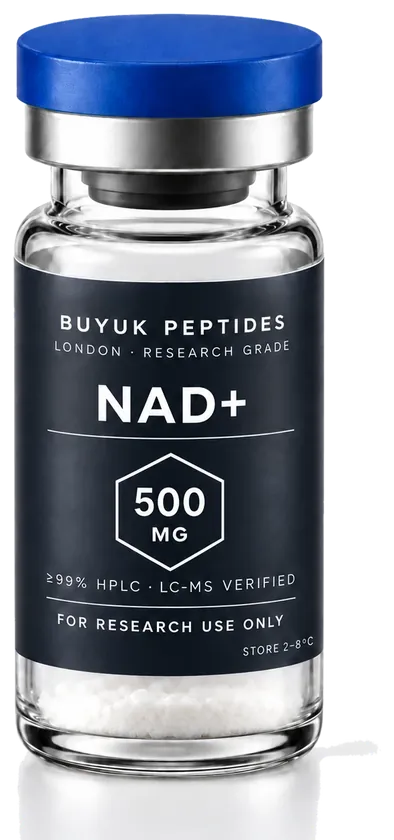
What NAD+ is
NAD+, nicotinamide adenine dinucleotide, is a coenzyme present in every living cell. It is not a peptide, although it is often listed and searched for alongside peptides as "NAD+ peptide"; it is a small-molecule research reagent: a dinucleotide, built from an adenosine monophosphate and a nicotinamide mononucleotide joined through a pyrophosphate bridge, containing no amino acids. We list it because laboratories working on mitochondrial biology order it alongside the peptides in that area, and we test and certify it batch by batch in the same way.
The molecule exists in two redox states. NAD+ is the oxidised form, which accepts a hydride to become NADH, and the pair carries electrons between the dehydrogenases of glycolysis, the citric acid pathway and the respiratory chain. Beyond redox chemistry, NAD+ is a substrate consumed by three enzyme families that have drawn most recent attention: the sirtuin deacylases, the poly(ADP-ribose) polymerases and the CD38 family of hydrolases, all of which cleave the molecule at the glycosidic bond to release nicotinamide. The molecular weight is approximately 663 g/mol and the CAS number for the free acid is 53-84-9. NAD+ belongs to the mitochondrial and coenzymes class.
The published literature on the compound, with references, is collected in the monograph.
What you receive
Each vial contains β-NAD+ free acid as a white lyophilised powder, sealed with a flip-off cap over a crimped stopper, in the net quantity stated on the label: 500 mg. There is no carrier or other excipient unless the batch certificate says otherwise. The batch number is printed on the label and matches the certificate in our register.
Reading the certificate for an NAD+ batch
The certificate for a coenzyme reads differently from one for a peptide. Purity by HPLC is reported as the area of the main peak against all peaks, and for NAD+ the peaks that matter are its two breakdown products, nicotinamide and ADP-ribose, which appear when the glycosidic bond hydrolyses. A fresh, well-stored batch shows them at well under one percent; a certificate showing several percent indicates material that has been exposed to moisture or heat. Identity by LC-MS is reported as the observed mass against the expected mass of about 663 Da. Net content gives the milligrams of NAD+ actually present, calculated for the free acid.
Our guide to reading a certificate of analysis walks through annotated examples, and HPLC and LC-MS explained covers the methods.
Storage and handling
Sealed vials should be kept at −20 °C, desiccated and protected from light; 2 to 8 °C is acceptable for short periods. NAD+ is hygroscopic and moisture is the main cause of degradation in the solid, so allow the vial to reach room temperature before opening, work quickly and reseal with the cap tight. In solution it is stable for some days refrigerated at slightly acidic pH but breaks down within hours at alkaline pH or at room temperature, so neutral or buffered solutions should be prepared fresh and used the same day, and stock solutions frozen in aliquots. The storage and stability guide covers this in more detail.