What Semax is
Semax is a synthetic heptapeptide with the sequence Met-Glu-His-Phe-Pro-Gly-Pro. The first four residues are positions 4 to 7 of adrenocorticotropic hormone (ACTH), a fragment chosen because it has no endocrine action of its own. The Pro-Gly-Pro tripeptide was added to the C-terminus to protect the fragment from the peptidases that would otherwise clear it within minutes.
Semax was developed at the Institute of Molecular Genetics of the Russian Academy of Sciences, which also produced Selank. The molecular weight is approximately 814 g/mol and the CAS number is 80714-61-0. Unlike the full hormone, the ACTH(4–7) fragment has no activity at the MC2 receptor and does not stimulate the adrenal cortex. Semax belongs to the neuropeptides and other class.
The published literature on the compound, with references, is collected in the monograph.
What you receive
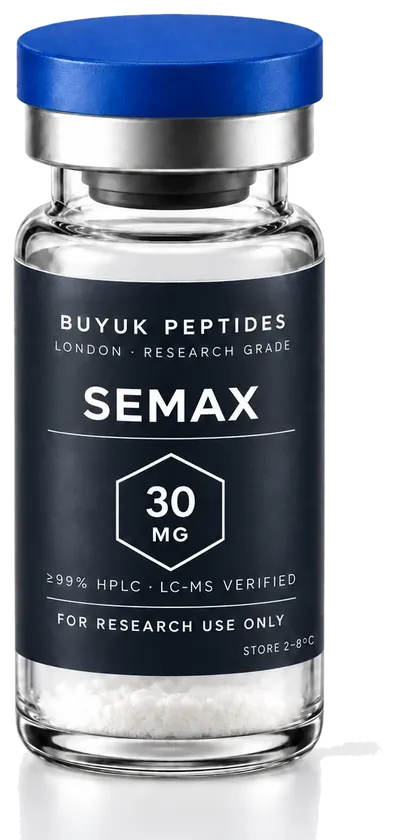
Each vial contains Semax as a white lyophilised powder, sealed with a flip-off cap over a crimped stopper, in the net quantity stated on the label: 30 mg. There is no carrier, mannitol or other excipient unless the batch certificate says otherwise. The batch number is printed on the label and matches the certificate in our register.
Reading the certificate for a Semax batch
Purity by reversed-phase HPLC is reported as the area of the main peak against all peaks and should be above 99%. Identity by LC-MS is reported as the observed mass against the expected mass of about 814 Da, usually seen as the singly charged ion near 815 and the doubly charged ion near 408. Net content gives the milligrams of peptide actually present, as distinct from the nominal fill.
The specific thing to check on a Semax certificate is methionine oxidation. The N-terminal methionine converts to its sulfoxide on exposure to air, and the product is 16 Da heavier and elutes slightly earlier on HPLC. A well-made and well-stored batch shows this at a fraction of a percent; a certificate showing several percent of the sulfoxide indicates poor handling somewhere in the chain. Deletion sequences missing one proline, 97 Da lighter, are the other impurity to expect. Our guide to reading a certificate of analysis walks through annotated examples, and HPLC and LC-MS explained covers the methods.
Storage and handling
Sealed vials should be kept refrigerated at 2 to 8 °C and protected from light; −20 °C is preferable beyond a few months, and the methionine makes this more important for Semax than for peptides without an oxidisable residue. Allow the vial to reach room temperature before opening to avoid condensation, and reseal promptly, since both moisture and oxygen accelerate sulfoxide formation. Semax dissolves readily in water or buffer. Solutions are best prepared fresh, or aliquoted and frozen under nitrogen or argon where possible; the storage and stability guide covers solvents, concentrations and freeze-thaw behaviour.