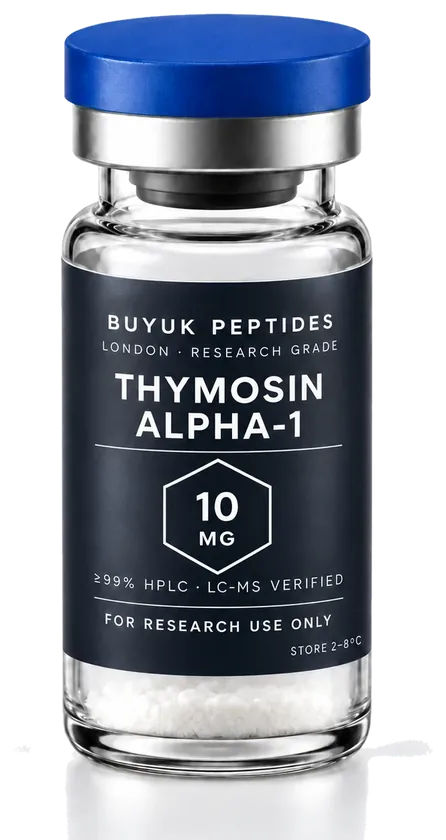
What thymosin alpha-1 is
Thymosin alpha-1 is a 28-residue peptide with an acetylated N-terminus, first isolated in 1977 by Allan Goldstein and colleagues from thymosin fraction 5, a partially purified extract of calf thymus. It was later shown to correspond to the first 28 residues of prothymosin α, a highly conserved and abundant nuclear protein, from which it is thought to be produced by proteolytic cleavage. The sequence is unusually acidic, with nine glutamate and aspartate residues against four lysines, and contains no aromatic residues, no methionine and no cysteine.
The synthetic peptide, under the international non-proprietary name thymalfasin, has been manufactured since the 1980s and is licensed as a medicine in a number of countries, though not in the United Kingdom or the European Union. The molecular weight is approximately 3,108 g/mol and the CAS number is 62304-98-7. Thymosin alpha-1 belongs to the neuropeptides and other class.
The published literature on the compound, with references, is collected in the monograph.
What you receive
Each vial contains thymosin alpha-1 as a white lyophilised powder, sealed with a flip-off cap over a crimped stopper, in the net quantity stated on the label: 10 mg. There is no carrier, mannitol or other excipient unless the batch certificate says otherwise. The batch number is printed on the label and matches the certificate in our register.
Reading the certificate for a thymosin alpha-1 batch
Purity by reversed-phase HPLC is reported as the area of the main peak against all peaks and should be above 98% for a 28-residue synthetic peptide; a sequence of this length has more scope for deletion products than a short one, and anything above 99% reflects careful purification. Identity by LC-MS is reported as the deconvoluted mass against the expected mass of about 3,108 Da. The raw spectrum shows a series of multiply charged ions, typically from three to five protons, and the laboratory combines these into a single neutral mass. Net content gives the milligrams of peptide actually present, as distinct from the nominal fill.
The impurities to expect are single-residue deletion sequences, the des-acetyl peptide at 42 Da lighter, and deamidation of the C-terminal asparagine, which adds about 1 Da and produces a slightly earlier-eluting peak. With no oxidisable residues, sulfoxide products are not a concern. Our guide to reading a certificate of analysis walks through annotated examples, and HPLC and LC-MS explained covers the methods.
Storage and handling
Sealed vials should be kept refrigerated at 2 to 8 °C and protected from light; −20 °C is preferable beyond a few months. Highly acidic peptides are hygroscopic and this one will absorb moisture quickly from a cold, opened vial, so allow it to reach room temperature before opening and reseal promptly. The dry powder is stable for well over a year. Thymosin alpha-1 is very soluble in water and in neutral buffers, giving a clear solution with no tendency to aggregate. Solutions should be prepared fresh or aliquoted and frozen; the storage and stability guide covers solvents, concentrations and freeze-thaw behaviour.