Free Royal Mail Tracked 24 on every order · Same-day dispatch before 3pmIndependent HPLC and LC-MS certificate on every batch
BuyUK PeptidesResearch peptides, London
Home/Catalogue/Mitochondrial compounds & coenzymes/5-Amino-1MQ
Mitochondrial compounds & coenzymes · CAS 42464-96-0

5-Amino-1MQ

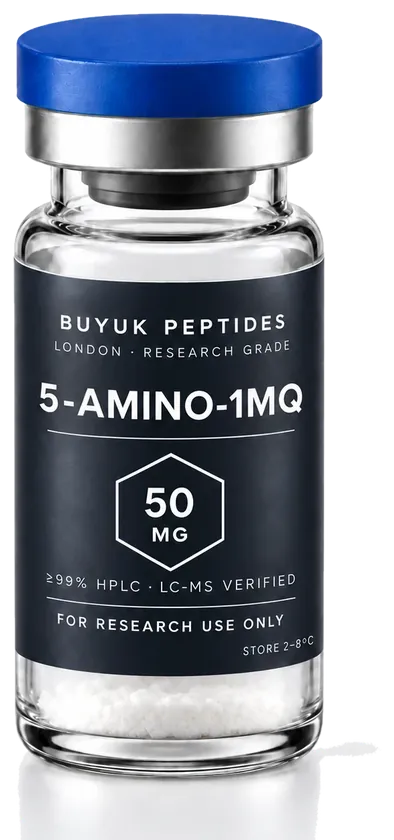
A small-molecule inhibitor of nicotinamide N-methyltransferase, not a peptide, supplied as a research reagent in 50 mg vials with an independent HPLC and LC-MS certificate published for every batch.

Vial size
£46.00BK-5A1MQ-50 · Out of stock

Certificate for this size is being published and will be linked here before dispatch.

Certificate of analysisAwaiting
5-Amino-1MQ

No batch of this vial has been released yet. A batch is released only once its independent report is in and published here. Until then it cannot be ordered.

About 5-Amino-1MQ

Written for laboratory researchers from the published literature. Not medical advice; nothing on this page describes use in humans or animals.

What 5-Amino-1MQ is

5-Amino-1MQ is 5-amino-1-methylquinolinium, a small synthetic molecule built on a quinoline ring that carries a methyl group on the ring nitrogen, giving it a permanent positive charge, and an amino group at the 5-position. It is not a peptide. It was reported in 2017 by Stanton Watowich, Harshini Neelakantan and colleagues at the University of Texas Medical Branch as the lead compound from a programme of inhibitors of nicotinamide N-methyltransferase (NNMT), designed around the structure of the enzyme's nicotinamide substrate.

NNMT methylates nicotinamide using S-adenosylmethionine as the methyl donor. An inhibitor that occupies the nicotinamide site therefore gives researchers a tool for studying the enzyme's role in NAD+ metabolism and methyl-group balance in cultured cells. The cation has a molecular weight of approximately 159 g/mol, the CAS number for the compound is 42464-96-0, and it sits in our mitochondrial and coenzymes class alongside NAD+ and the mitochondria-targeted peptides.

The published literature on the compound, with references, is collected in the monograph.

What you receive

Each vial contains 5-Amino-1MQ as a pale yellow to yellow crystalline powder, supplied as a salt, sealed with a flip-off cap over a crimped stopper, in the net quantity stated on the label: 50 mg. There is no carrier or other excipient unless the batch certificate says otherwise. The batch number is printed on the label and matches the certificate in our register.

Reading the certificate for a 5-Amino-1MQ batch

Purity by reversed-phase HPLC is reported as the area of the main peak against all peaks and should be above 98% for a small synthetic molecule of this kind; the common impurity is the unmethylated 5-aminoquinoline starting material, which is readily separated and should be present at well under 1%. Identity by LC-MS is reported as the observed mass of the quinolinium cation against the expected value of about 159 Da. Since the compound carries a permanent positive charge it ionises very efficiently in positive-mode electrospray, and the spectrum normally shows the intact cation without the counter-ion. Net content gives the milligrams of the salt actually in the vial, as distinct from the nominal fill.

The main thing to check is that the laboratory has stated which salt was analysed, since the cation accounts for a different fraction of the gross weight depending on the counter-ion. Our guide to reading a certificate of analysis walks through annotated examples, and HPLC and LC-MS explained describes the methods.

Storage and handling

Sealed vials should be kept refrigerated at 2 to 8 °C and protected from light; the compound is a stable crystalline salt and tolerates brief periods at room temperature, but −20 °C is preferable for storage beyond a year. Quinolinium salts are moderately hygroscopic, so allow the vial to reach room temperature before opening and reseal promptly. 5-Amino-1MQ dissolves readily in water, bacteriostatic water or dimethyl sulfoxide to give a yellow solution. Aqueous solutions are stable refrigerated for some weeks if protected from light; the storage and stability guide covers solvents, concentrations and freeze-thaw behaviour for small molecules as well as peptides.

Specification

Reference values pending verification against the batch certificate.

CAS number
42464-96-0
Molecular formula
C10H11ClN2
Molecular weight
194.66 g/mol
Appearance
Yellow to orange powder
Purity
≥99% by RP-HPLC, per batch certificate
Net content
50 mg
Storage, sealed
Room temperature or below; protect from light and moisture
Storage, reconstituted
2–8 °C; use within the period stated in the compound monograph
Research use
In-vitro laboratory research only

Questions about 5-Amino-1MQ

Is 5-Amino-1MQ a peptide?

No. It is a small organic molecule, a substituted quinolinium salt with no amino-acid residues at all, and we list it alongside the peptides only because it appears in the same mitochondrial and metabolic literature. The analytical methods are the same, HPLC purity and LC-MS identity, but there is no sequence to confirm and no peptide content to calculate; the certificate reports net content of the salt by weight.

What does NNMT inhibitor mean?

Nicotinamide N-methyltransferase is an enzyme that transfers a methyl group from S-adenosylmethionine to nicotinamide, producing 1-methylnicotinamide and consuming a precursor that would otherwise feed NAD+ synthesis. 5-Amino-1MQ was designed to occupy the nicotinamide site of that enzyme and block the reaction. The published work characterises it as a selective, membrane-permeable inhibitor suitable for cell-culture experiments.

What does the certificate for a 5-Amino-1MQ batch show?

HPLC purity as area-percent of the main peak, LC-MS identity as the observed mass of the quinolinium cation against the expected value of about 159 Da, and the net content per vial by weight. Because the compound is a permanently charged cation, it is supplied as a salt, and the certificate names the counter-ion where the laboratory has determined it. The signed PDF is linked from the batch page.

Why is 5-Amino-1MQ sold in a 50 mg vial?

It is a light molecule, so 50 mg is a large molar quantity, and the published cell-culture work uses it at micromolar concentrations across many wells and time points. A single 50 mg vial therefore covers an extended series of experiments without the need to reorder, while keeping a single batch, and a single certificate, behind the whole study. Larger quantities can be arranged on request.

What is in the vial?

5-Amino-1MQ as a yellow to orange powder, sealed under nitrogen, in the net quantity stated on the label. No carrier, no excipient unless the certificate says otherwise.

Which batch will I receive?

None yet. A size is released for sale only once its batch report is published here.

How is purity measured?

By reversed-phase HPLC at an independent laboratory, reported as the area of the main peak against all peaks. Identity is confirmed by LC-MS against the expected mass.

How should the sealed vial be stored?

Room temperature or below; protect from light and moisture

When is my order dispatched?

Same day for orders placed before 3pm, Monday to Saturday, by Royal Mail Tracked 24. Delivery is free.

Who may buy?

Researchers and institutions aged 18 or over, for in-vitro laboratory use under our terms. Nothing we sell is for human or veterinary use.

Chat on WhatsApp