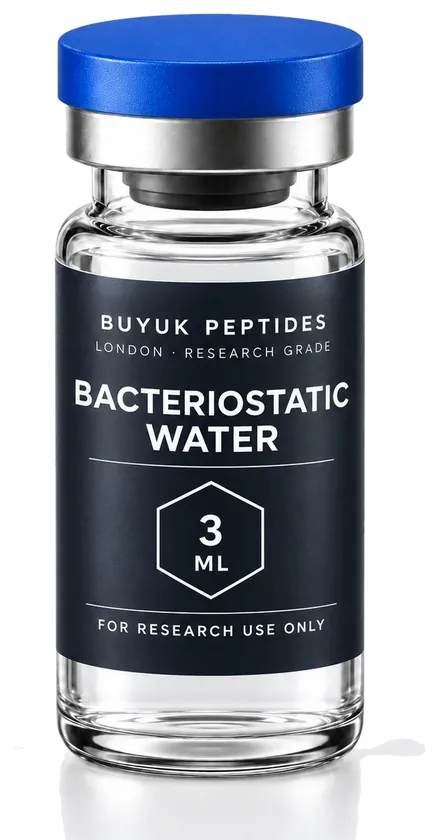
What bacteriostatic water is
Bacteriostatic water, usually shortened to "bac water", is purified water that has been sterilised, filled into glass vials with a rubber stopper and crimped cap, and preserved with 0.9% w/v benzyl alcohol. The benzyl alcohol does not sterilise; it inhibits the multiplication of bacteria and fungi that may enter the vial when the stopper is pierced, which is what makes the vial suitable for repeated draws over a period of weeks rather than a single opening. The water itself is of the grade used for pharmaceutical preparations, free of pyrogens and particulates at the time of filling. The CAS number for water is 7732-18-5; the product is listed in our consumables class.
What it is for in the laboratory
It is the standard solvent for reconstituting lyophilised research peptides, which is why it is often searched for as bacteriostatic water for peptides: the preservative lets a multi-dose vial of solution be opened more than once without bacterial growth, where plain sterile water should be used once.
Every peptide in the catalogue is supplied as a lyophilised powder, and the first step in any experiment is to return it to solution. Bacteriostatic water is the default solvent for that step. A measured volume is drawn from the solvent vial and added through the stopper of the peptide vial, the powder is allowed to dissolve without shaking, and the resulting stock is then diluted into buffer or culture medium for the assay. Because the solvent is preserved, a stock made with it keeps better in the refrigerator than one made with plain water, and the solvent vial itself can be used again for the next reconstitution.
The solvent suits the great majority of the catalogue: short hydrophilic sequences such as BPC-157 and KPV, the copper complexes such as GHK-Cu, and the lipidated incretin analogues such as semaglutide, which are formulated to dissolve at near-neutral pH. A few hydrophobic or strongly basic peptides dissolve poorly in water and go into solution more readily in dilute acetic acid; the storage and stability guide lists which. Note that benzyl alcohol at 0.9% is not benign to cultured cells, so a stock made with bacteriostatic water should be diluted substantially into medium rather than added to a culture at high proportion; for designs where even trace preservative is a concern, a plain sterile buffer is the better choice. Nothing on this page describes use in humans or animals; the product is supplied for laboratory use only.
What you receive
Each vial contains sterile water with 0.9% benzyl alcohol as a clear, colourless liquid, sealed with a flip-off cap over a crimped stopper, in the volume stated on the label: 3 mL or 10 mL. The vial is slightly overfilled so that the stated volume can be withdrawn. The lot number and expiry are printed on the label.
Storage and handling
Unopened vials should be stored at room temperature, 15 to 25 °C, protected from light and not frozen; freezing can cause the stopper to shift and compromise the seal. Once the stopper has been pierced, the vial should be kept refrigerated at 2 to 8 °C and the contents used within 28 days, after which the preservative can no longer be relied on; mark the date of first use on the label. Wipe the stopper with alcohol before each draw and use fresh sterile transfer equipment every time. The storage and stability guide covers how long reconstituted peptide solutions keep and when to aliquot and freeze them.
Related consumables and compounds
Acetic acid 0.6% is the alternative reconstitution solvent for peptides that dissolve poorly at neutral pH. The peptides most often reconstituted in bacteriostatic water include BPC-157, TB-500, GHK-Cu and the incretin analogues such as semaglutide and tirzepatide. The storage and stability guide gives solvent recommendations compound by compound.