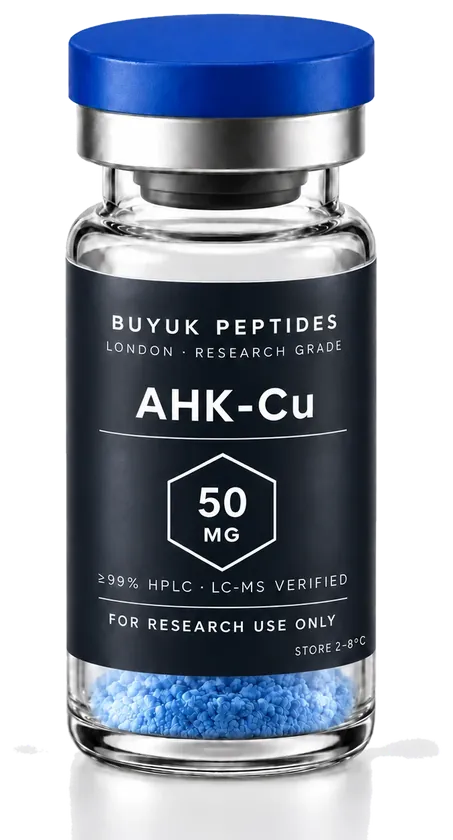
What AHK-Cu is
AHK-Cu is the copper(II) complex of the synthetic tripeptide L-alanyl-L-histidyl-L-lysine. It is a close structural variant of GHK-Cu, the naturally occurring plasma peptide complex, differing only in the first residue, where alanine replaces glycine. The histidine imidazole, the terminal amino group and the backbone amide nitrogen coordinate the copper in the same arrangement as in GHK-Cu, and the complex shares the characteristic blue colour of that compound.
Unlike GHK, the AHK sequence is not reported as a naturally occurring plasma factor; it was made as an analogue to examine how changes at the first position affect the behaviour of the copper complex. The free tripeptide has a molecular weight of approximately 354 g/mol, 14 g/mol more than GHK on account of the extra methyl group. No CAS number is listed for this product, as explained in the questions above. It belongs to the copper and melanocortin peptides class.
The published literature on the compound, with references, is collected in the monograph.
What you receive
Each vial contains AHK-Cu as a blue lyophilised powder, sealed with a flip-off cap over a crimped stopper, in the net quantity stated on the label: 50 mg. There is no carrier or other excipient unless the batch certificate says otherwise. The batch number is printed on the label and matches the certificate in our register.
Reading the certificate for an AHK-Cu batch
Three results matter, with the same complication that applies to any metal-peptide complex. Purity by reversed-phase HPLC is reported as the area of the main peak against all peaks and should be above 99%, since a tripeptide synthesis has very little scope for deletion products. Identity by LC-MS needs careful reading: the copper is usually stripped from the peptide under the acidic conditions of electrospray ionisation, so the spectrum typically shows the free AHK ion at about 355 rather than the complex. The 14 Da difference from GHK is clearly resolved, so the result also confirms that you have the alanine variant and not its more common relative. Where the laboratory reports copper content separately, that figure confirms that the complex was formed. Net content gives the milligrams of material actually in the vial, as distinct from the nominal fill.
The usual minor impurities are diketopiperazine, a cyclic by-product that short peptides form readily, and residual counter-ion. Our guide to reading a certificate of analysis walks through annotated examples, and the copper peptides compared guide discusses what to look for on a copper peptide certificate in particular.
Storage and handling
Sealed vials should be kept refrigerated at 2 to 8 °C and protected from light; −20 °C is preferable for storage beyond a few months. Copper tripeptide complexes are hygroscopic and the powder will clump and darken if it absorbs moisture, so allow the vial to reach room temperature before opening and reseal promptly. AHK-Cu dissolves readily in water to give a blue solution. The copper can be lost to chelating agents, so buffers and media containing EDTA should be avoided; the storage and stability guide covers solvents, concentrations and freeze-thaw behaviour.