Free Royal Mail Tracked 24 on every order · Same-day dispatch before 3pmIndependent HPLC and LC-MS certificate on every batch
BuyUK PeptidesResearch peptides, London
Home/Catalogue/Copper & melanocortin peptides/GHK-Cu
Copper & melanocortin peptides · 3 amino acids · CAS 89030-95-5

GHK-Cu

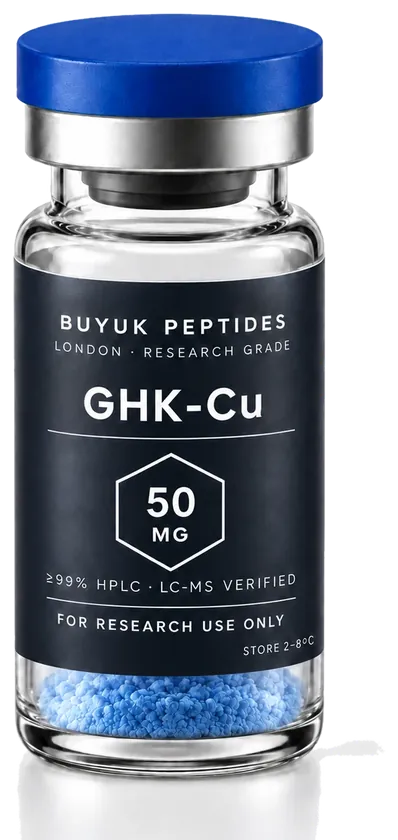
The copper(II) complex of the tripeptide Gly-His-Lys, first isolated from human plasma, supplied as a blue lyophilised research powder in 50 and 100 mg vials with an independent HPLC and LC-MS certificate for every batch.

Vial size
£16.00BK-GHK-50 · In stock, dispatched today before 3pm
Certificate of analysisLot BK-GHK-50
GHK-Cu 50 mg
Purity, RP-HPLC, 220 nm
99.93 %
Laboratory
Janoshik

About GHK-Cu

Written for laboratory researchers from the published literature. Not medical advice; nothing on this page describes use in humans or animals.

What GHK-Cu is

GHK-Cu is the copper(II) complex of the tripeptide glycyl-L-histidyl-L-lysine. It is the compound usually meant by "copper peptide", and is also written GHKCu, Cu-GHK, GHK copper peptide and, in cosmetic ingredient lists, Copper Tripeptide-1. The peptide was isolated from human plasma by Loren Pickart in 1973 and later shown to bind copper(II) with high affinity; most of the published work concerns the copper complex rather than the free peptide.

The copper is coordinated by the imidazole nitrogen of the histidine, the terminal amino group and the deprotonated amide nitrogen of the glycine-histidine bond, with the lysine side-chain free. This arrangement gives the complex its blue colour and a characteristic absorbance spectrum. The free tripeptide has a molecular weight of approximately 340 g/mol and the 1:1 copper complex approximately 404 g/mol. The CAS number for the complex is 89030-95-5. GHK-Cu is the parent compound of the copper and melanocortin peptides class and the main component of the GLOW and KLOW blends.

The published literature on the compound, with references, is collected in the monograph.

What you receive

Each vial contains GHK-Cu as a blue lyophilised powder, sealed with a flip-off cap over a crimped stopper, in the net quantity stated on the label: 50 or 100 mg. There is no carrier or other excipient unless the batch certificate says otherwise. The batch number is printed on the label and matches the certificate in our register.

Reading the certificate for a GHK-Cu batch

Three results matter, with one complication specific to metal complexes. Purity by reversed-phase HPLC is reported as the area of the main peak against all peaks and should be above 99%, since a tripeptide synthesis has very little scope for deletion products. Identity by LC-MS needs careful reading: the copper is usually stripped from the peptide under the acidic conditions of electrospray ionisation, so the spectrum typically shows the free GHK ion at about 341 rather than the complex at 404. A good certificate notes this and, where measured, reports copper content separately so that the complex can be confirmed. Net content gives the milligrams of material actually in the vial, as distinct from the nominal fill.

The usual minor impurities are diketopiperazine, a cyclic by-product that short peptides form readily, and residual counter-ion. Our guide to reading a certificate of analysis walks through annotated examples, and the copper peptides compared guide discusses what to look for on a copper peptide certificate in particular.

Storage and handling

Sealed vials should be kept refrigerated at 2 to 8 °C and protected from light; −20 °C is preferable for storage beyond a few months. GHK-Cu is noticeably hygroscopic and the powder will clump and darken if it absorbs moisture, so allow the vial to reach room temperature before opening and reseal promptly. The complex dissolves readily in water to give a blue solution. Solutions are reasonably stable refrigerated but the copper can be lost to chelating agents in buffers, so EDTA-containing media should be avoided; the storage and stability guide covers solvents, concentrations and freeze-thaw behaviour.

Specification

Reference values pending verification against the batch certificate.

CAS number
89030-95-5
Molecular formula
C14H24N6O4Cu
Molecular weight
403.9 g/mol
Sequence
Gly-His-Lys (copper(II) complex)
Appearance
Blue to blue-violet lyophilised powder
Purity
≥99% by RP-HPLC, per batch certificate
Net content
50 mg, 100 mg
Storage, sealed
2–8 °C short term; −20 °C or below long term; protect from light; avoid freeze–thaw cycles
Storage, reconstituted
2–8 °C; use within the period stated in the compound monograph
Research use
In-vitro laboratory research only

Questions about GHK-Cu

How does GHK-Cu differ from AHK-Cu?

Both are copper complexes of a tripeptide ending in His-Lys. GHK-Cu has glycine at the first position and is the naturally occurring plasma peptide described by Pickart in 1973, with by far the larger literature. AHK-Cu replaces the glycine with alanine and is a synthetic variant with a smaller body of in-vitro work. The 14 Da difference in peptide mass is visible on the LC-MS result.

What does the certificate for a GHK-Cu batch show?

It reports purity by reversed-phase HPLC as area-percent of the main peak, identity by LC-MS and the net content per vial. Under electrospray conditions the copper usually dissociates, so the mass spectrum shows the free tripeptide at about 340 Da rather than the complex; where the laboratory reports copper content separately, that figure confirms the complex was formed. The signed PDF is linked from the batch page.

Why is GHK-Cu offered in 50 and 100 mg vials?

GHK-Cu is a small molecule, about 404 g/mol for the complex, and the in-vitro literature uses it at micromolar concentrations across many samples, so a laboratory consumes it in larger quantities than a long peptide. It is also inexpensive to synthesise. The 50 mg size suits a single study; 100 mg lowers the per-milligram cost for extended work. Both come from a batch with a published certificate.

Is GHK-Cu the same as copper peptide?

Usually, yes. When a product or paper says copper peptide without qualification it almost always means GHK-Cu, the copper complex of Gly-His-Lys, which is the original and by far the most studied copper peptide; its INCI name is Copper Tripeptide-1. Other copper peptides exist, such as AHK-Cu, so a certificate should name the peptide and show its mass rather than only saying copper peptide.

What is the difference between GHK and GHK-Cu?

GHK is the free tripeptide glycyl-L-histidyl-L-lysine, a white powder of about 340 g/mol. GHK-Cu is that peptide with one copper(II) ion bound, about 404 g/mol, and is blue. Nearly all of the published research uses the copper complex, which is what we supply; a vial labelled GHK-Cu that is white has been supplied as the free peptide.

Why is the powder blue?

The colour comes from the copper(II) ion coordinated by the peptide's histidine imidazole, the amino terminus and backbone nitrogens. Free GHK without copper is white, so a blue powder is itself a rough visual check that the complex is present. The intensity varies with the copper-to-peptide ratio, which the certificate states where the laboratory has measured it. Solutions are blue to violet depending on pH.

What is in the vial?

GHK-Cu as a blue to blue-violet lyophilised powder, sealed under nitrogen, in the net quantity stated on the label. No carrier, no excipient unless the certificate says otherwise.

Which batch will I receive?

The batch shown in the certificate panel for the size you choose. Its number is printed on the vial and on your dispatch note, and its full report is on the batch page.

How is purity measured?

By reversed-phase HPLC at an independent laboratory, reported as the area of the main peak against all peaks. Identity is confirmed by LC-MS against the expected mass.

How should the sealed vial be stored?

2–8 °C short term; −20 °C or below long term; protect from light; avoid freeze–thaw cycles

When is my order dispatched?

Same day for orders placed before 3pm, Monday to Saturday, by Royal Mail Tracked 24. Delivery is free.

Who may buy?

Researchers and institutions aged 18 or over, for in-vitro laboratory use under our terms. Nothing we sell is for human or veterinary use.

Chat on WhatsApp