Free Royal Mail Tracked 24 on every order · Same-day dispatch before 3pmIndependent HPLC and LC-MS certificate on every batch
BuyUK PeptidesResearch peptides, London
Home/Catalogue/Peptide fragments/AOD-9604
Peptide fragments · 16 amino acids · CAS 221231-10-3

AOD-9604

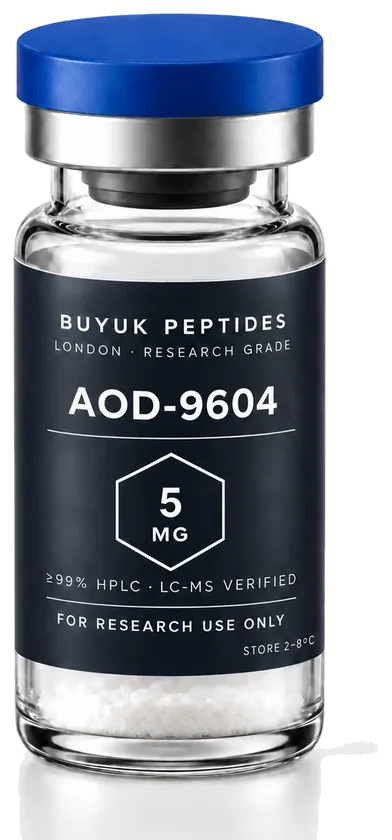
A modified 16-residue fragment of human growth hormone corresponding to residues 176 to 191, supplied as a lyophilised research powder in 5 mg vials, with an independent HPLC and LC-MS certificate published for every batch.

Vial size
£28.00BK-AOD-5 · Out of stock
Certificate of analysisLot PEPTIDETAI2026118
AOD-9604 5 mg
Purity, RP-HPLC, 220 nm
99.22 %
Net peptide content
5.2 mg
Tested
23 Feb 2026
Laboratory
Janoshik

About AOD-9604

Written for laboratory researchers from the published literature. Not medical advice; nothing on this page describes use in humans or animals.

What AOD-9604 is

AOD-9604 is a synthetic peptide of 16 amino acids that reproduces the C-terminal region of human growth hormone, residues 176 to 191, with an additional tyrosine at the N-terminus. It was developed at Monash University in Melbourne in the 1990s by a group led by Frank Ng, who were mapping the C-terminal region of the growth hormone molecule.

The sequence retains the disulfide bridge between the two cysteines of the parent protein, corresponding to Cys182 and Cys189 of growth hormone, so the peptide is cyclic across most of its length. It carries no lipid or other modification beyond the added tyrosine. The average molecular weight is approximately 1,815 g/mol and the CAS number is 221231-10-3. The published literature on the compound, with references, is collected in the monograph.

What you receive

Each vial contains AOD-9604 as a white lyophilised powder, sealed with a flip-off cap over a crimped stopper, in the net quantity stated on the label: 5 mg. There is no carrier, mannitol or other excipient unless the batch certificate says otherwise. The batch number is printed on the label and matches the certificate in our register.

Reading the certificate for an AOD-9604 batch

Purity by reversed-phase HPLC is reported as the area of the main peak against all peaks and should be above 99% for a peptide of this length. Identity by LC-MS is reported as the observed mass against the expected mass of about 1,815 Da. The disulfide bridge matters here: the oxidised, bridged form is two daltons lighter than the reduced open-chain form, and a careful certificate will state which is expected and show that the observed mass matches. A batch in which a substantial fraction remains reduced, or in which two chains have paired through intermolecular disulfides to give a dimer at roughly twice the mass, has been handled poorly. Net peptide content gives the milligrams of peptide actually present after allowing for water and counter-ions.

Typical impurities are deletion sequences, a small amount of the reduced form, and a trace of dimer, all of which separate from the main peak on HPLC. At the sub-1% level these are normal. Our guide to reading a certificate of analysis shows annotated examples, and HPLC and LC-MS explained describes the methods.

Storage and handling

Sealed vials should be kept refrigerated at 2 to 8 °C and protected from light; −20 °C is preferable for storage beyond a few months, and the lyophilised powder is stable for well over a year under those conditions. Allow the vial to reach room temperature before opening to avoid condensation on the powder. The peptide dissolves in water or bacteriostatic water; solutions for in-vitro work should avoid thiol reagents such as dithiothreitol, which reduce the disulfide, unless the open form is wanted. Solutions should be prepared fresh or aliquoted and frozen; the storage and stability guide covers solvents, concentrations and aliquoting.

Specification

Reference values pending verification against the batch certificate.

CAS number
221231-10-3
Molecular formula
C78H123N23O23S2
Molecular weight
1815.1 g/mol
Sequence
YLRIVQCRSVEGSCGF (Tyr-hGH 177-191)
Appearance
White to off-white lyophilised powder
Purity
≥99% by RP-HPLC, per batch certificate
Net content
5 mg
Storage, sealed
2–8 °C short term; −20 °C or below long term; protect from light; avoid freeze–thaw cycles
Storage, reconstituted
2–8 °C; use within the period stated in the compound monograph
Research use
In-vitro laboratory research only

Questions about AOD-9604

What is the relationship between AOD-9604 and growth hormone?

AOD-9604 is a synthetic copy of the C-terminal end of human growth hormone, residues 176 to 191, with a tyrosine added at the N-terminus. It is a fragment, not the hormone, and the published work reports that it does not act at the growth hormone receptor or raise IGF-1 in the models studied. It was designed to isolate one region of the parent protein for investigation on its own.

What does the certificate for an AOD-9604 batch show?

HPLC purity as area-percent of the main peak, LC-MS identity as the observed mass against the expected mass of about 1,815 Da, net peptide content per vial, and the laboratory that ran the tests. The sequence contains two cysteines joined by a disulfide bridge, and a correct mass, two daltons below the open form, confirms the bridge is in place.

Why is AOD-9604 offered only in 5 mg?

At about 1,815 g/mol a 5 mg vial is a large molar quantity for a peptide used mainly in cell-culture and adipocyte assays, and demand has not justified a separate larger batch. Several vials from one batch share a single certificate, so laboratories needing more can order accordingly. We will add a size if demand settles at a level that warrants it.

What does the 'modified' in 'modified fragment' mean?

The native fragment 176–191 was found to be unstable, so the research group at Monash University added a tyrosine residue to the N-terminus to improve stability and handling, giving the 16-residue sequence sold as AOD-9604. The internal disulfide between the two cysteines is retained from the parent protein. The modification is reflected in the expected mass on the certificate.

What is in the vial?

AOD-9604 as a white to off-white lyophilised powder, sealed under nitrogen, in the net quantity stated on the label. No carrier, no excipient unless the certificate says otherwise.

Which batch will I receive?

The batch shown in the certificate panel for the size you choose. Its number is printed on the vial and on your dispatch note, and its full report is on the batch page.

How is purity measured?

By reversed-phase HPLC at an independent laboratory, reported as the area of the main peak against all peaks. Identity is confirmed by LC-MS against the expected mass.

How should the sealed vial be stored?

2–8 °C short term; −20 °C or below long term; protect from light; avoid freeze–thaw cycles

When is my order dispatched?

Same day for orders placed before 3pm, Monday to Saturday, by Royal Mail Tracked 24. Delivery is free.

Who may buy?

Researchers and institutions aged 18 or over, for in-vitro laboratory use under our terms. Nothing we sell is for human or veterinary use.

Chat on WhatsApp