Free Royal Mail Tracked 24 on every order · Same-day dispatch before 3pmIndependent HPLC and LC-MS certificate on every batch
BuyUK PeptidesResearch peptides, London
Home/Catalogue/Peptide fragments/BPC-157
Peptide fragments · 15 amino acids · CAS 137525-51-0

BPC-157

A 15-residue synthetic peptide derived from the sequence of a human gastric protein, supplied as a lyophilised research powder in 5 mg and 10 mg vials, with an independent HPLC and LC-MS certificate published for every batch.

Vial size
£11.00BK-BPC-5 · In stock, dispatched today before 3pm
Certificate of analysisLot BK-BPC-5
BPC-157 5 mg
Purity, RP-HPLC, 220 nm
98.93 %
Laboratory
Independent, named on the report

About BPC-157

Written for laboratory researchers from the published literature. Not medical advice; nothing on this page describes use in humans or animals.

What BPC-157 is

BPC-157, also written BPC157 and often searched as "BPC 157 peptide", is a synthetic pentadecapeptide, fifteen amino acids long, with the sequence Gly-Glu-Pro-Pro-Pro-Gly-Lys-Pro-Ala-Asp-Asp-Ala-Gly-Leu-Val. It was first described by Predrag Sikirić and colleagues at the University of Zagreb as a partial sequence of a protein isolated from human gastric juice, which they called Body Protection Compound; the number refers to the fragment they synthesised and studied. It has no disulfide bridge, no lipid and no N- or C-terminal modification, and it is unusually stable in acidic conditions, a property the original authors attributed to its origin in the stomach.

The molecule is notable for how much published work exists on so simple a sequence. It is small, hydrophilic and free of the oxidation-prone residues that complicate the analysis of longer peptides. The average molecular weight is approximately 1,419 g/mol and the CAS number is 137525-51-0. The published literature on the compound, with references, is collected in the monograph.

What you receive

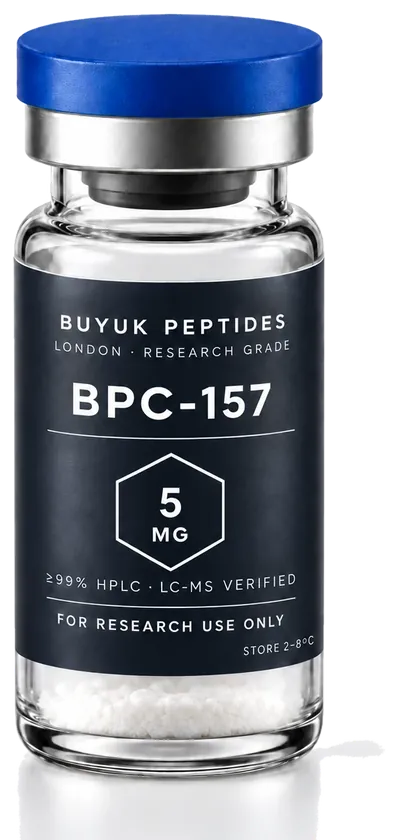
Each vial contains BPC-157 as a white lyophilised powder, sealed with a flip-off cap over a crimped stopper, in the net quantity stated on the label: 5 mg or 10 mg. There is no carrier, mannitol or other excipient unless the batch certificate says otherwise. The batch number is printed on the label and matches the certificate in our register.

Reading the certificate for a BPC-157 batch

Purity by reversed-phase HPLC is reported as the area of the main peak against all peaks and should be above 99% for a peptide this short; anything much lower suggests a poorly executed synthesis. Identity by LC-MS is reported as the observed mass against the expected mass of about 1,419 Da. For a peptide with no modifications the mass check is straightforward, and the main thing it rules out is a deletion sequence missing one of the five proline or two aspartate residues, which would be visible as a mass difference of around 97 or 115 daltons respectively. Net peptide content gives the milligrams of peptide actually present after allowing for water and the acetate or arginate counter-ion.

The impurities seen with BPC-157 are usually deletion sequences and a small amount of aspartimide-related product from the Asp-Asp pair, both of which elute close to the main peak. At the sub-1% level these are normal. Our guide to reading a certificate of analysis shows annotated examples, and HPLC and LC-MS explained describes the methods.

Storage and handling

Sealed vials should be kept refrigerated at 2 to 8 °C and protected from light; −20 °C is preferable for storage beyond a few months, and the lyophilised powder is stable for well over a year under those conditions. BPC-157 is less hygroscopic than the lipidated peptides, but it is still good practice to allow the vial to reach room temperature before opening. The peptide dissolves readily in water, saline or bacteriostatic water and is stable in solution at refrigerator temperature for longer than most peptides, a property documented in the original literature; it also tolerates mildly acidic conditions. The storage and stability guide covers solvents, concentrations and aliquoting.

Specification

Reference values pending verification against the batch certificate.

CAS number
137525-51-0
Molecular formula
C62H98N16O22
Molecular weight
1419.55 g/mol
Sequence
GEPPPGKPADDAGLV
Appearance
White to off-white lyophilised powder
Purity
≥99% by RP-HPLC, per batch certificate
Net content
5 mg, 10 mg
Storage, sealed
2–8 °C short term; −20 °C or below long term; protect from light; avoid freeze–thaw cycles
Storage, reconstituted
2–8 °C; use within the period stated in the compound monograph
Research use
In-vitro laboratory research only
What is the difference between BPC-157 and TB-500?

They are unrelated molecules that happen to be studied in overlapping fields. BPC-157 is a 15-residue fragment of a gastric protein with no post-translational modification. TB-500 is a seven-residue N-acetylated fragment of thymosin beta-4 that carries the actin-binding motif. The two are often ordered together, which is why we also offer them co-lyophilised as a blend.

Why 5 mg and 10 mg vials?

BPC-157 is a short, light peptide of about 1,419 g/mol, so 5 mg already represents a large molar quantity and is enough for an extended series of cell-culture or stability assays. The 10 mg vial lowers the cost per milligram for laboratories running repeated protocols. Both sizes come from batches with their own published certificate.

What does the certificate for a BPC-157 batch show?

HPLC purity as area-percent of the main peak, LC-MS identity as the observed mass against the expected mass of about 1,419 Da, net peptide content per vial, and the laboratory that performed the tests. Because the sequence contains no cysteine, methionine or tryptophan, the impurity profile is usually simple and the purity figure is typically high.

Is there a difference between the acetate and arginate salt forms?

Both are the same peptide with a different counter-ion from purification. The arginate salt has been described in the literature as more stable in solution, but either form gives the same molecule on dissolution. The certificate states the net peptide content after allowing for the counter-ion, so the figure is comparable regardless of salt form.

What is in the vial?

BPC-157 as a white to off-white lyophilised powder, sealed under nitrogen, in the net quantity stated on the label. No carrier, no excipient unless the certificate says otherwise.

Which batch will I receive?

The batch shown in the certificate panel for the size you choose. Its number is printed on the vial and on your dispatch note, and its full report is on the batch page.

How is purity measured?

By reversed-phase HPLC at an independent laboratory, reported as the area of the main peak against all peaks. Identity is confirmed by LC-MS against the expected mass.

How should the sealed vial be stored?

2–8 °C short term; −20 °C or below long term; protect from light; avoid freeze–thaw cycles

When is my order dispatched?

Same day for orders placed before 3pm, Monday to Saturday, by Royal Mail Tracked 24. Delivery is free.

Who may buy?

Researchers and institutions aged 18 or over, for in-vitro laboratory use under our terms. Nothing we sell is for human or veterinary use.

Chat on WhatsApp