Free Royal Mail Tracked 24 on every order · Same-day dispatch before 3pmIndependent HPLC and LC-MS certificate on every batch
BuyUK PeptidesResearch peptides, London
Home/Catalogue/Neuropeptides & other compounds/Epithalon
Neuropeptides & other compounds · 4 amino acids · CAS 307297-39-8

Epithalon, Epitalon

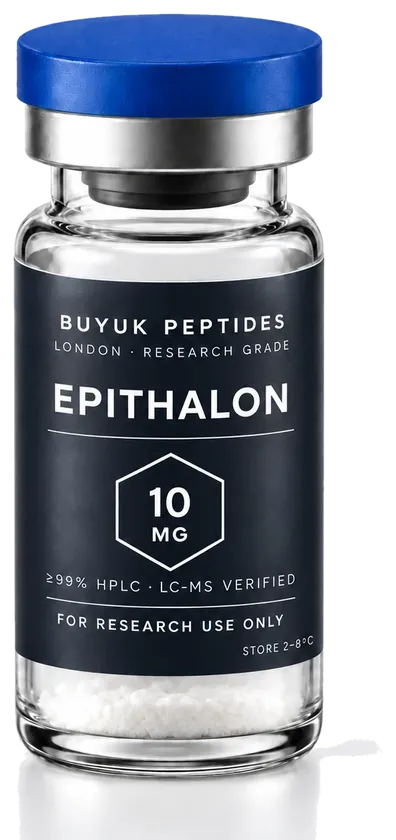
The synthetic tetrapeptide Ala-Glu-Asp-Gly, modelled on a peptide fraction of the pineal gland, supplied as a lyophilised research powder in 10 mg vials with an independent HPLC and LC-MS certificate for every batch.

Vial size
£19.00BK-EPI-10 · Out of stock
Certificate of analysisLot BK-EPI-10
Epithalon 10 mg
Purity, RP-HPLC, 220 nm
99.67 %
Laboratory
Marfleet

About Epithalon

Written for laboratory researchers from the published literature. Not medical advice; nothing on this page describes use in humans or animals.

What Epithalon is

Epithalon, also written Epitalon, is the synthetic tetrapeptide alanyl-glutamyl-aspartyl-glycine (Ala-Glu-Asp-Gly). It was designed by Vladimir Khavinson and colleagues at the St Petersburg Institute of Bioregulation and Gerontology as a defined analogue of Epithalamin, a polypeptide extract of bovine pineal gland that the same group had studied since the 1970s. The tetrapeptide was chosen to reproduce the amino-acid composition of the active fraction of the extract in a single molecule that could be synthesised and characterised.

The molecule is small and strongly acidic: two of its four residues carry carboxylic acid side-chains, and with the free C-terminus it has three negative charges at neutral pH. The molecular weight is approximately 390 g/mol and the CAS number is 307297-39-8. Epithalon belongs to the neuropeptides and other class and is one of several short synthetic peptides of Russian origin in the catalogue, alongside Selank and Semax.

The published literature on the compound, with references, is collected in the monograph.

What you receive

Each vial contains Epithalon as a white lyophilised powder, sealed with a flip-off cap over a crimped stopper, in the net quantity stated on the label: 10 mg. There is no carrier, mannitol or other excipient unless the batch certificate says otherwise. The batch number is printed on the label and matches the certificate in our register.

Reading the certificate for an Epithalon batch

Purity by reversed-phase HPLC is reported as the area of the main peak against all peaks and should be above 99% for a four-residue peptide. Identity by LC-MS is reported as the observed mass against the expected mass of about 390 Da, either as the protonated ion near 391 or, for an acidic peptide like this one, as the deprotonated ion near 389 in negative-ion mode. Net content gives the milligrams of peptide actually present, as distinct from the nominal fill.

The impurity specific to this sequence is the aspartimide-derived isomer discussed in the questions above, which has the same mass but a different retention time. A trace of the Ala-Glu diketopiperazine may also appear. Our guide to reading a certificate of analysis walks through annotated examples, and HPLC and LC-MS explained covers the methods.

Storage and handling

Sealed vials should be kept refrigerated at 2 to 8 °C and protected from light; −20 °C is preferable beyond a few months. Short acidic peptides are markedly hygroscopic and Epithalon will clump if it absorbs moisture, so allow the vial to reach room temperature before opening and reseal promptly. The peptide has no oxidisable residues and the dry powder is stable for well over a year. It dissolves readily in water, where the solution is mildly acidic; in buffer it is fully soluble at neutral pH. Solutions should be prepared fresh or aliquoted and frozen, since the aspartimide rearrangement proceeds faster in solution, as the storage and stability guide explains.

Specification

Reference values pending verification against the batch certificate.

CAS number
307297-39-8
Molecular formula
C14H22N4O9
Molecular weight
390.35 g/mol
Sequence
Ala-Glu-Asp-Gly
Appearance
White to off-white lyophilised powder
Purity
≥99% by RP-HPLC, per batch certificate
Net content
10 mg
Storage, sealed
2–8 °C short term; −20 °C or below long term; protect from light; avoid freeze–thaw cycles
Storage, reconstituted
2–8 °C; use within the period stated in the compound monograph
Research use
In-vitro laboratory research only

Questions about Epithalon

Is Epithalon the same thing as Epitalon or Epithalamin?

Epithalon and Epitalon are two spellings of the same synthetic tetrapeptide, Ala-Glu-Asp-Gly, arising from transliteration of the Russian name. Epithalamin is different: it is the original extract of bovine pineal gland, a mixture of peptides, from which the tetrapeptide was derived as a defined synthetic analogue. Only the tetrapeptide can be characterised by HPLC and LC-MS, and that is what this product is.

What does the certificate for an Epithalon batch show?

It reports purity by reversed-phase HPLC as area-percent of the main peak, identity by LC-MS against an expected mass of about 390 Da, and the net content per vial. The peptide is strongly acidic, so some laboratories run the mass spectrometer in negative-ion mode and report the ion at about 389 rather than the protonated ion at 391. Either is a valid identity result. The signed PDF is linked from the batch page.

Why is Epithalon offered in a 10 mg vial?

At about 390 g/mol, 10 mg is roughly 26 micromoles, which covers a long series of cell-culture experiments at the micromolar concentrations the literature reports. It is enough for most research programmes without leaving material in the freezer for years. A single size also keeps every customer on the same tested batch, with one certificate covering it.

Why does the certificate sometimes show a second peak with the same mass?

The Asp-Gly sequence in Epithalon is the classic site for aspartimide formation, a rearrangement during synthesis or storage that produces an isomer in which the peptide bond runs through the aspartate side-chain. The isomer has the same mass as the correct peptide, so LC-MS cannot distinguish it, but it elutes separately on HPLC. A well-made batch shows it at a fraction of a percent.

What is in the vial?

Epithalon as a white to off-white lyophilised powder, sealed under nitrogen, in the net quantity stated on the label. No carrier, no excipient unless the certificate says otherwise.

Which batch will I receive?

The batch shown in the certificate panel for the size you choose. Its number is printed on the vial and on your dispatch note, and its full report is on the batch page.

How is purity measured?

By reversed-phase HPLC at an independent laboratory, reported as the area of the main peak against all peaks. Identity is confirmed by LC-MS against the expected mass.

How should the sealed vial be stored?

2–8 °C short term; −20 °C or below long term; protect from light; avoid freeze–thaw cycles

When is my order dispatched?

Same day for orders placed before 3pm, Monday to Saturday, by Royal Mail Tracked 24. Delivery is free.

Who may buy?

Researchers and institutions aged 18 or over, for in-vitro laboratory use under our terms. Nothing we sell is for human or veterinary use.

Chat on WhatsApp