Free Royal Mail Tracked 24 on every order · Same-day dispatch before 3pmIndependent HPLC and LC-MS certificate on every batch
BuyUK PeptidesResearch peptides, London
Home/Catalogue/Blends/GLOW blend
Blends

GLOW blend

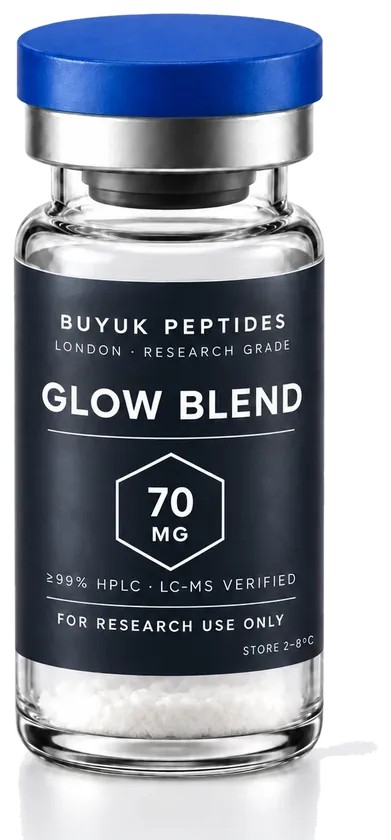
GHK-Cu, BPC-157 and TB-500 co-lyophilised in a single 70 mg vial, 50 mg, 10 mg and 10 mg respectively, supplied as a research powder with an independent HPLC and LC-MS certificate published for every batch.

Vial size
£65.00BK-GLOW-70 · Out of stock
Certificate of analysisLot BK-GLOW-70
GLOW blend 70 mg
Purity, RP-HPLC, 220 nm
99.12 %
Tested
25 Jun 2026
Laboratory
Janoshik

About GLOW blend

Written for laboratory researchers from the published literature. Not medical advice; nothing on this page describes use in humans or animals.

What the GLOW blend is

GLOW, often listed as the GLOW peptide blend, is a co-lyophilised preparation of three peptides that are frequently ordered together: GHK-Cu, the copper(II) complex of the tripeptide Gly-His-Lys first isolated from human plasma; BPC-157, the 15-residue fragment of a human gastric protein; and TB-500, the N-acetylated seven-residue fragment of thymosin beta-4 that carries its actin-binding motif. The three are dissolved together in the stated amounts, 50 mg, 10 mg and 10 mg, freeze-dried together in a single vial. The resulting blue powder is a physical mixture at a fixed ratio by mass, not a conjugate; the peptides are not covalently linked and behave independently once in solution.

GHK-Cu dominates the vial by mass and by moles, since at roughly 404 g/mol for the complex 50 mg is about 124 micromoles, against about 7 micromoles of BPC-157 and 11 micromoles of TB-500. The blend is listed in our blends class.

What you receive

Each vial contains the three peptides as a blue lyophilised powder, sealed with a flip-off cap over a crimped stopper, in the net quantities stated on the label: 50 mg of GHK-Cu, 10 mg of BPC-157 and 10 mg of TB-500, 70 mg in total. There is no carrier, mannitol or other excipient unless the batch certificate says otherwise. The batch number is printed on the label and matches the certificate in our register. The limitation of a blend is its fixed ratio; a design that needs any component varied independently should use the single-compound vials.

Reading the certificate for a GLOW batch

A three-component certificate has more to check than a single-compound one. Identity by LC-MS is confirmed for each component in turn: the laboratory looks for about 340 Da for the GHK tripeptide, since the copper is normally stripped under the acidic conditions of electrospray ionisation and the free peptide is what appears, about 1,419 Da for BPC-157 and about 889 Da for TB-500. A good certificate notes the copper dissociation and, where measured, reports copper content separately so that the complex can be confirmed. Purity by reversed-phase HPLC shows three main peaks, and the reported purity is their combined area against all peaks; above 98% is expected for a well-made lot. Net content is reported for the vial as a whole and, where quantified against standards, per component.

The impurities expected are those of the individual peptides: diketopiperazine from GHK, deletion sequences and aspartimide-related product from BPC-157, and deletion sequences from TB-500. Our guide to reading a certificate of analysis includes a blend example, and the copper peptides compared guide discusses the copper-specific points.

Storage and handling

Sealed vials should be kept refrigerated at 2 to 8 °C and protected from light; −20 °C is preferable for storage beyond a few months. GHK-Cu is noticeably hygroscopic and will clump and darken if it absorbs moisture, so allow the vial to reach room temperature before opening and reseal promptly. The powder dissolves readily in water or bacteriostatic water to give a blue solution containing all three peptides. Chelating agents such as EDTA will strip the copper from GHK, so buffers containing them should be avoided, and solutions should be aliquoted and frozen for anything beyond short-term refrigerated use. The storage and stability guide covers solvents, concentrations and freeze-thaw behaviour.

Specification

Reference values pending verification against the batch certificate.

Components
GHK-Cu 50 mg · BPC-157 10 mg · TB-500 10 mg
Appearance
Pale blue lyophilised powder
Purity
≥99% by RP-HPLC, per batch certificate
Net content
70 mg
Storage, sealed
2–8 °C short term; −20 °C or below long term; protect from light; avoid freeze–thaw cycles
Storage, reconstituted
2–8 °C; use within the period stated in the compound monograph
Research use
In-vitro laboratory research only

Questions about GLOW blend

What is in the GLOW blend and in what amounts?

Three peptides co-lyophilised in one vial: 50 mg of GHK-Cu, the copper(II) complex of Gly-His-Lys; 10 mg of BPC-157, the 15-residue gastric peptide fragment; and 10 mg of TB-500, the N-acetylated actin-binding fragment of thymosin beta-4. The total is 70 mg of peptide material. The name is a catalogue label, not a chemical one, and the components are not joined to one another.

How does GLOW differ from KLOW?

KLOW contains everything GLOW does plus 10 mg of KPV, the C-terminal tripeptide of alpha-melanocyte-stimulating hormone, for a total of 80 mg. The three shared components are present in the same amounts in both. A laboratory that does not need KPV in its design chooses GLOW; one that wants all four in a single vial at the fixed ratio chooses KLOW.

Why is the powder blue?

GHK-Cu makes up the majority of the vial by mass, and the copper(II) ion coordinated by its histidine gives the complex a blue colour that carries through co-lyophilisation. BPC-157 and TB-500 are white on their own. A blue powder is therefore a rough visual check that the copper complex is present; the certificate confirms it properly by mass spectrometry and, where measured, copper content.

What does the certificate for a GLOW batch show?

The laboratory confirms each of the three components by LC-MS, looking for about 340 Da for the free GHK tripeptide, since the copper usually dissociates under electrospray conditions, 1,419 Da for BPC-157 and 889 Da for TB-500, and reports the combined HPLC purity across the three main peaks. Net content is reported for the vial as a whole and, where quantified, per component. The signed PDF is linked from the batch page.

What is in the vial?

GLOW blend as a pale blue lyophilised powder, sealed under nitrogen, in the net quantity stated on the label. No carrier, no excipient unless the certificate says otherwise.

Which batch will I receive?

The batch shown in the certificate panel for the size you choose. Its number is printed on the vial and on your dispatch note, and its full report is on the batch page.

How is purity measured?

By reversed-phase HPLC at an independent laboratory, reported as the area of the main peak against all peaks. Identity is confirmed by LC-MS against the expected mass.

How should the sealed vial be stored?

2–8 °C short term; −20 °C or below long term; protect from light; avoid freeze–thaw cycles

When is my order dispatched?

Same day for orders placed before 3pm, Monday to Saturday, by Royal Mail Tracked 24. Delivery is free.

Who may buy?

Researchers and institutions aged 18 or over, for in-vitro laboratory use under our terms. Nothing we sell is for human or veterinary use.

Chat on WhatsApp