What retatrutide is
Retatrutide is a synthetic peptide of 39 amino acids designed to activate three receptors in the incretin and glucagon family at once: the glucose-dependent insulinotropic polypeptide receptor (GIPR), the glucagon-like peptide-1 receptor (GLP-1R) and the glucagon receptor (GCGR). It was developed at Eli Lilly under the code LY3437943 and is the most studied of the so-called "triple agonists", a class that extends the dual-agonist approach of tirzepatide by one further receptor.
The molecule follows the design conventions of the long-acting incretin analogues. Non-natural residues near the N-terminus (2-aminoisobutyric acid and an α-methyl leucine) protect it from the enzyme DPP-4, and a C20 fatty diacid attached through a linker to a lysine side-chain binds reversibly to serum albumin, which is what gives the compound its roughly six-day half-life reported for it. The C-terminus is amidated. The average molecular weight is approximately 4,731 g/mol and the CAS number is 2381089-83-2.
The published literature on the compound, with references, is collected in the monograph.
What you receive
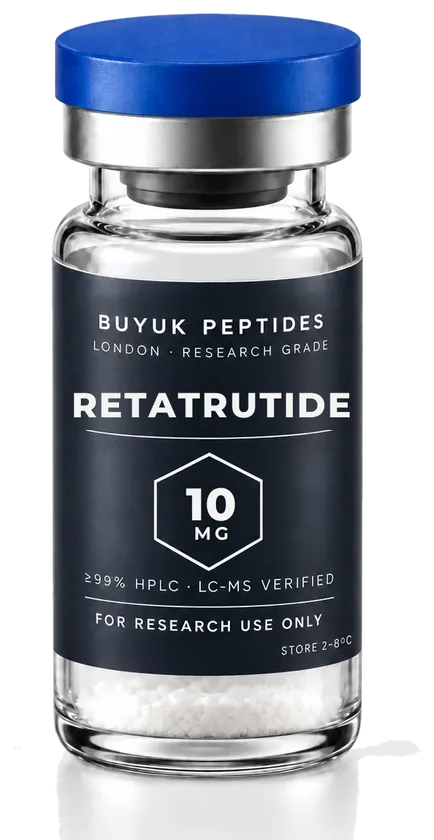
Each vial contains retatrutide as a white to off-white lyophilised powder, sealed with a flip-off cap over a crimped stopper, in the net quantity stated on the label: 10, 20, 30 or 40 mg. There is no carrier, mannitol or other excipient unless the batch certificate says otherwise. The batch number is printed on the label and matches the certificate in our register.
The same batch is supplied to every customer who orders that size while it is shipping, so the figures on the certificate are the figures for your vial, not a representative example. When a batch sells out, the next one is tested and published before the size is listed again, which is why a size occasionally shows "awaiting certificate".
Reading the certificate for a retatrutide batch
Three results matter. Purity by reversed-phase HPLC is reported as the area of the main peak against all peaks and should be above 99% for a well-made lot. Identity by LC-MS is reported as the observed mass against the expected mass of about 4,731 Da; a match within the instrument's tolerance confirms the sequence and the lipid modification are present. Net peptide content tells you how many milligrams of peptide are actually in the vial, as distinct from the nominal fill, which matters when you are calculating concentrations.
A long lipidated peptide like retatrutide tends to show a small cluster of late-eluting impurities on HPLC, usually incomplete deprotection or oxidation products. These are normal at the sub-1% level; a certificate showing several percent of them is a reason to ask questions. Our guide to reading a certificate of analysis goes through this with annotated examples.
Storage and handling
Sealed vials should be kept refrigerated at 2 to 8 °C, protected from light; for storage beyond a few months, −20 °C is preferable. The lyophilised powder is stable for well over a year under those conditions. Lipidated peptides are more hygroscopic than short unmodified ones, so allow the vial to reach room temperature before opening to avoid condensation on the powder. Reconstituted solutions are a different matter and should be prepared fresh or aliquoted and frozen; the storage and stability guide covers solvents, concentrations and freeze-thaw behaviour.