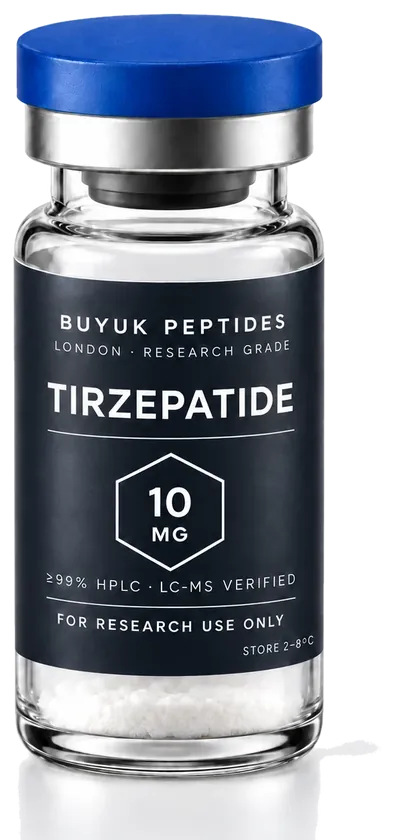
What tirzepatide is
Tirzepatide is a synthetic peptide of 39 amino acids that activates two receptors of the incretin family: the glucose-dependent insulinotropic polypeptide receptor (GIPR) and the glucagon-like peptide-1 receptor (GLP-1R). It was developed at Eli Lilly under the code LY3298176 and is the reference compound for the multi-agonist approach that retatrutide later extended to a third receptor.
The sequence is built on a GIP backbone rather than a GLP-1 backbone, with substitutions that give it activity at both receptors. Two 2-aminoisobutyric acid residues, at positions 2 and 13, protect the chain from cleavage by DPP-4, and a C20 fatty diacid attached through a hydrophilic linker to the lysine at position 20 binds reversibly to serum albumin, which accounts for its roughly five-day half-life. The C-terminus is amidated. The average molecular weight is approximately 4,814 g/mol and the CAS number is 2023788-19-2.
The published literature on the compound, with references, is collected in the monograph.
What you receive
Each vial contains tirzepatide as a white to off-white lyophilised powder, sealed with a flip-off cap over a crimped stopper, in the net quantity stated on the label: 10, 20 or 40 mg. There is no carrier, mannitol or other excipient unless the batch certificate says otherwise. The batch number is printed on the label and matches the certificate in our register.
Reading the certificate for a tirzepatide batch
Three results matter. Purity by reversed-phase HPLC is reported as the area of the main peak against all peaks and should be above 99% for a well-made lot. Identity by LC-MS is reported as the observed mass against the expected mass of about 4,814 Da; a match within the instrument's tolerance confirms that both the sequence and the C20 diacid modification are present, since a missing or truncated lipid would shift the mass by several hundred daltons. Net peptide content gives the milligrams of peptide actually in the vial, as distinct from the nominal fill, which is the figure you need when preparing stock solutions.
Like other long lipidated peptides, tirzepatide tends to show a small group of late-eluting impurities on HPLC, usually deletion sequences or incompletely removed protecting groups. These are normal at the sub-1% level; several percent is a reason to ask questions. Our guide to reading a certificate of analysis walks through annotated examples.
Storage and handling
Sealed vials should be kept refrigerated at 2 to 8 °C and protected from light; for storage beyond a few months, −20 °C is preferable. The lyophilised powder is stable for well over a year under those conditions. Lipidated peptides are more hygroscopic than short unmodified ones, so allow the vial to reach room temperature before opening to avoid condensation on the powder. Tirzepatide dissolves readily at neutral pH, so bacteriostatic water or a phosphate buffer is a suitable solvent for in-vitro work. Reconstituted solutions should be prepared fresh or aliquoted and frozen; the storage and stability guide covers solvents, concentrations and freeze-thaw behaviour.