Free Royal Mail Tracked 24 on every order · Same-day dispatch before 3pmIndependent HPLC and LC-MS certificate on every batch
BuyUK PeptidesResearch peptides, London
Home/Catalogue/GHRH, GHS & IGF analogues/IGF-1 LR3
GHRH, GHS & IGF analogues · 83 amino acids · CAS 946870-92-4

IGF-1 LR3

A recombinant 83-residue analogue of human insulin-like growth factor 1 with reduced binding to IGF-binding proteins, supplied as a lyophilised research protein in 1 mg vials with an independent certificate for every batch.

Vial size
£68.00BK-IGF-1 · Out of stock

Certificate for this size is being published and will be linked here before dispatch.

Certificate of analysisAwaiting
IGF-1 LR3

No batch of this vial has been released yet. A batch is released only once its independent report is in and published here. Until then it cannot be ordered.

About IGF-1 LR3

Written for laboratory researchers from the published literature. Not medical advice; nothing on this page describes use in humans or animals.

What IGF-1 LR3 is

IGF-1 LR3, or Long R3 IGF-1 (also written IGF1 LR3, IGF1-LR3 and IGF 1 LR3), is a recombinant analogue of human insulin-like growth factor 1. Native IGF-1 is a 70-residue single-chain protein with three disulphide bonds. The LR3 variant carries two modifications: a substitution of arginine for the glutamate at position 3, and a 13-residue extension at the N-terminus derived from a porcine growth hormone sequence, giving 83 residues in all. It was developed at GroPep in Adelaide in the late 1980s and early 1990s, and the arginine substitution in particular sharply reduces its affinity for the six IGF-binding proteins that otherwise sequester IGF-1 in serum and in culture media.

Because it escapes the binding proteins while retaining activity at the IGF-1 receptor, LR3 IGF-1 became a standard growth factor supplement in serum-free media for mammalian cell lines, particularly in recombinant protein production. It is a protein rather than a synthetic peptide, which affects how it is made, tested and handled. The intact mass is approximately 9,111 Da and the CAS number is 946870-92-4.

The published literature on the compound, with references, is collected in the monograph.

What you receive

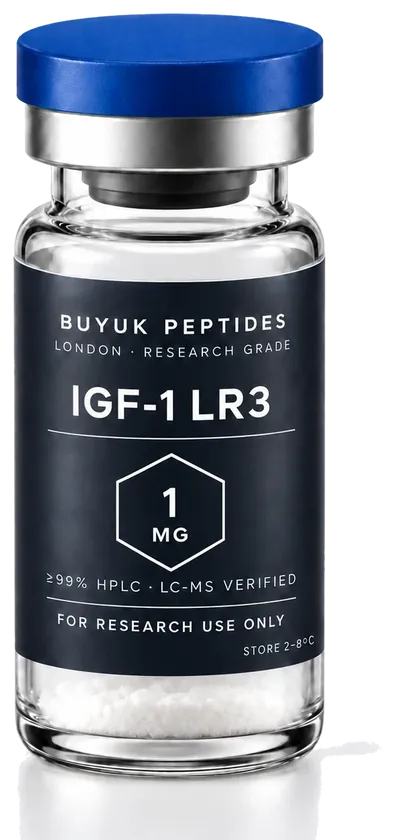
Each vial contains IGF-1 LR3 as a white lyophilised powder, sealed with a flip-off cap over a crimped stopper, in the net quantity stated on the label: 1 mg. The protein is lyophilised from a dilute acid solution and the certificate states whether any carrier or buffer salt is present. The batch number is printed on the label and matches the certificate in our register.

Reading the certificate for an IGF-1 LR3 batch

A recombinant protein is certified a little differently from a synthetic peptide. Purity by reversed-phase HPLC is reported as the area of the main peak against all peaks, and a well-made lot should be above 95%; some laboratories add SDS-PAGE as a second view. Identity is confirmed by electrospray mass spectrometry, where the many charge states of a 9 kDa protein are deconvoluted to an intact mass compared against the expected value of about 9,111 Da. A match confirms the full sequence with the N-terminal extension and that all three disulphide bonds are formed.

Protein content, the counterpart of net peptide content, is usually determined by UV absorbance at 280 nm or by a colourimetric assay and is the figure to use when preparing a stock solution. A correctly folded and a misfolded protein share the same mass, so the HPLC retention time, and where reported a cell-based activity assay, are the checks on folding. Our guide to reading a certificate of analysis walks through annotated examples.

Storage and handling

Sealed vials should be kept at −20 °C and protected from light; 2 to 8 °C is acceptable for short periods. The lyophilised protein is stable for well over a year frozen. Allow the vial to reach room temperature before opening so that condensation does not form on the powder. LR3 IGF-1 is sparingly soluble at neutral pH and is normally reconstituted in dilute acid, for which acetic acid 0.6% is the appropriate solvent, before further dilution into buffer or medium. Reconstituted solutions should be aliquoted and frozen in low-binding tubes, since proteins at low concentration adsorb to plastic; the storage and stability guide covers solvents, concentrations and freeze-thaw behaviour.

Specification

Reference values pending verification against the batch certificate.

CAS number
946870-92-4
Molecular formula
C400H625N111O115S9
Molecular weight
9111 g/mol
Appearance
White to off-white lyophilised powder
Purity
≥99% by RP-HPLC, per batch certificate
Net content
1 mg
Storage, sealed
2–8 °C short term; −20 °C or below long term; protect from light; avoid freeze–thaw cycles
Storage, reconstituted
2–8 °C; use within the period stated in the compound monograph
Research use
In-vitro laboratory research only

Questions about IGF-1 LR3

What does "LR3" mean?

Long R3 describes the two changes from native IGF-1. "Long" refers to a 13-residue extension at the N-terminus, derived from a porcine growth hormone sequence, and "R3" to the substitution of arginine for glutamate at position 3 of the IGF-1 sequence. Together they reduce affinity for the IGF-binding proteins that sequester native IGF-1, so more of the protein remains free in a culture medium.

Why is IGF-1 LR3 sold in 1 mg rather than larger vials?

It is a recombinant protein used in cell culture at nanogram-per-millilitre concentrations, so 1 mg prepares many litres of medium. Unlike synthetic short peptides, it cannot be made cheaply in bulk, and larger quantities would sit unused. A 1 mg vial from a single current batch, with its own certificate, is the practical size for most laboratories.

How is the certificate for a recombinant protein different?

Purity is still reported by reversed-phase HPLC, often with SDS-PAGE as a second method. Identity is confirmed by mass spectrometry as the deconvoluted intact mass against the expected value of about 9,111 Da, rather than a single protonated ion, since a protein of this size carries many charges. Protein content is usually measured by UV absorbance at 280 nm or a colourimetric assay rather than by amino acid analysis.

Is IGF-1 LR3 a synthetic peptide?

No. At 83 residues it is too long for routine solid-phase synthesis and is instead produced recombinantly, usually in Escherichia coli, then refolded so that its three disulphide bonds form correctly. That matters for a certificate, because a correctly folded protein and a misfolded one have the same mass; the HPLC retention time and biological activity data are what distinguish them.

What is in the vial?

IGF-1 LR3 as a white to off-white lyophilised powder, sealed under nitrogen, in the net quantity stated on the label. No carrier, no excipient unless the certificate says otherwise.

Which batch will I receive?

None yet. A size is released for sale only once its batch report is published here.

How is purity measured?

By reversed-phase HPLC at an independent laboratory, reported as the area of the main peak against all peaks. Identity is confirmed by LC-MS against the expected mass.

How should the sealed vial be stored?

2–8 °C short term; −20 °C or below long term; protect from light; avoid freeze–thaw cycles

When is my order dispatched?

Same day for orders placed before 3pm, Monday to Saturday, by Royal Mail Tracked 24. Delivery is free.

Who may buy?

Researchers and institutions aged 18 or over, for in-vitro laboratory use under our terms. Nothing we sell is for human or veterinary use.

Chat on WhatsApp