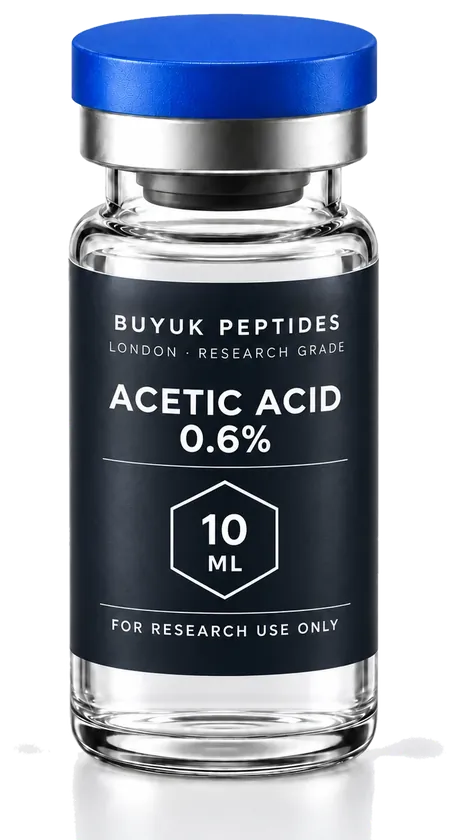
What acetic acid 0.6% is
This product is a sterile solution of glacial acetic acid in purified water at 0.6% w/v, which corresponds to approximately 0.1 mol/L and a pH of about 3. It is filled into glass vials with a rubber stopper and crimped cap and sterilised, with no preservative and no other additive. Acetic acid is the simplest weak organic acid, CAS number 64-19-7, and at this dilution it is a gentle solvent that lowers pH without introducing anything that interferes with later analysis. The product is listed in our consumables class.
What it is for in the laboratory
Most peptides in the catalogue dissolve readily in bacteriostatic water, but a minority do not. Peptides with few charged residues, or whose acidic and basic residues balance so that the molecule carries little net charge near pH 7, tend to aggregate rather than dissolve when water is added, producing a cloudy suspension or a gel that no amount of gentle swirling clears. In dilute acetic acid the basic side-chains and the N-terminus become fully protonated, the molecules acquire a net positive charge, repel one another and go into solution. The longer GHRH analogues such as CJC-1295 (no DAC), sermorelin and tesamorelin are frequently cited examples, and the storage and stability guide gives a compound-by-compound list.
The usual practice is to dissolve the peptide in a small volume of acetic acid first, then bring the stock to the final concentration with water or buffer. Because a 0.1 molar acid is weak and the volumes involved are small, the stock can be diluted into a buffered assay medium without shifting its pH to any meaningful degree; where the pH of the final solution matters, it is checked after dilution. The solvent is also useful in analytical work, since dilute acetic acid is compatible with reversed-phase HPLC and with electrospray ionisation and does not leave the ion-suppressing residue that trifluoroacetic acid can. Nothing on this page describes use in humans or animals; the product is supplied for laboratory use only.
What you receive
Each vial contains 0.6% acetic acid as a clear, colourless liquid with a faint vinegar odour, sealed with a flip-off cap over a crimped stopper, in the volume stated on the label: 10 mL. The vial is slightly overfilled so that the stated volume can be withdrawn. The lot number and expiry are printed on the label.
Storage and handling
Unopened vials should be stored at room temperature, 15 to 25 °C, protected from light and not frozen; freezing can shift the stopper and compromise the seal. Because there is no preservative, a vial is intended for single use once the stopper has been pierced; any remainder may be kept refrigerated for a short period for non-sterile purposes but should not be used for further reconstitution. Peptide stocks made in acetic acid are generally stable refrigerated for a few days and should be aliquoted and frozen beyond that. Acetic acid at this strength is mildly irritant to skin and eyes, so ordinary laboratory precautions apply. The storage and stability guide covers how long reconstituted solutions keep and when to aliquot and freeze them.
Related consumables and compounds
Bacteriostatic water is the default solvent for the rest of the catalogue and the one to use when a peptide dissolves readily at neutral pH. The compounds most often reconstituted in dilute acetic acid are the GHRH analogues CJC-1295 (no DAC), sermorelin and tesamorelin, and the blend that contains CJC-1295, the CJC-1295 / Ipamorelin blend. The storage and stability guide gives solvent recommendations compound by compound.