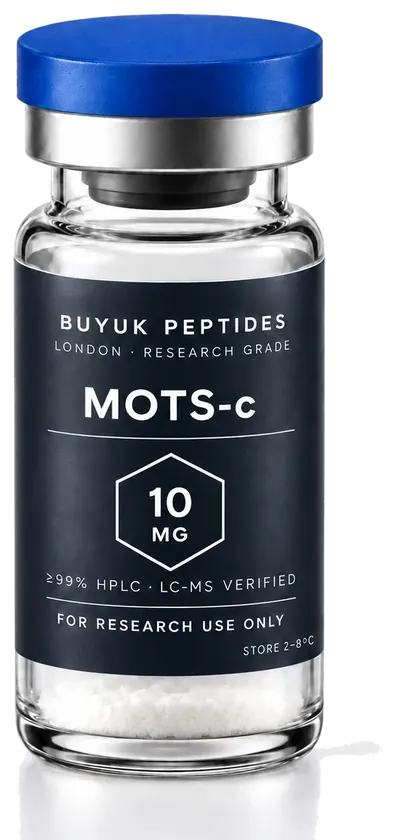
What MOTS-c is
MOTS-c, the mitochondrial open reading frame of the 12S ribosomal RNA type-c, is a 16-residue peptide with the sequence Met-Arg-Trp-Gln-Glu-Met-Gly-Tyr-Ile-Phe-Tyr-Pro-Arg-Lys-Leu-Arg. It was described in 2015 by Changhan Lee, Pinchas Cohen and colleagues at the University of Southern California, who identified a short open reading frame within the gene for the mitochondrial 12S rRNA and showed that it is translated into a peptide detectable in cells and in plasma. It belongs to a small group of mitochondrial-derived peptides, the best known of the others being humanin, that are encoded by the mitochondrial genome rather than the nucleus.
The sequence is distinctive in its mixture of hydrophobic aromatic residues and basic residues, with three arginines and a lysine against a tryptophan, a phenylalanine and two tyrosines, and it contains two methionines. The molecular weight is approximately 2,175 g/mol and the CAS number is 1627580-64-6. MOTS-c belongs to the mitochondrial and coenzymes class.
The published literature on the compound, with references, is collected in the monograph.
What you receive
Each vial contains MOTS-c as a white to off-white lyophilised powder, sealed with a flip-off cap over a crimped stopper, in the net quantity stated on the label: 10 or 40 mg. There is no carrier, mannitol or other excipient unless the batch certificate says otherwise. The batch number is printed on the label and matches the certificate in our register.
Reading the certificate for a MOTS-c batch
Purity by reversed-phase HPLC is reported as the area of the main peak against all peaks and should be above 98% for a 16-residue peptide of this composition. Identity by LC-MS is reported as the deconvoluted mass against the expected mass of about 2,175 Da, with the raw spectrum showing the doubly charged ion near 1,088 and the triply charged ion near 726. Net content gives the milligrams of peptide actually present, as distinct from the nominal fill.
The impurities specific to this sequence are the methionine sulfoxides. With two methionines, single oxidation adds 16 Da and double oxidation adds 32 Da, and each gives an earlier-eluting peak on HPLC. A good batch shows these at a fraction of a percent. Tryptophan oxidation and single-residue deletions are the other peaks to expect. Our guide to reading a certificate of analysis walks through annotated examples, and HPLC and LC-MS explained covers the methods.
Storage and handling
Sealed vials should be kept refrigerated at 2 to 8 °C and protected from light; −20 °C is preferable beyond a few months, and the two methionines make cold storage more important than for an unoxidisable peptide. The tryptophan and tyrosines are light-sensitive, so solutions belong in amber or foil-wrapped tubes. Allow the vial to reach room temperature before opening to avoid condensation, and reseal promptly. For reconstitution, dissolve first in a small volume of 0.6% acetic acid or another dilute acid, then dilute into the working buffer; adding water directly can leave the peptide as a suspension. Solutions should be aliquoted and frozen, as the storage and stability guide explains.