What sermorelin is
Sermorelin is the synthetic form of the first 29 amino acids of human growth-hormone-releasing hormone, with an amidated C-terminus. The native hormone is 44 residues long, but the work that followed its isolation in the early 1980s showed that the N-terminal 29 residues carry the full activity at the GHRH receptor, and this fragment became the standard tool for studying that receptor. Because it is the unmodified sequence, sermorelin is the reference against which the later substituted analogues, including CJC-1295 (no DAC), are usually described.
The sequence begins Tyr-Ala-Asp-Ala-Ile-Phe-Thr-Asn-Ser-Tyr-Arg-Lys-Val-Leu-Gly-Gln-Leu-Ser-Ala-Arg-Lys-Leu-Leu-Gln-Asp-Ile-Met-Ser-Arg-NH2. The alanine at position 2 makes it a substrate for dipeptidyl peptidase-4, the asparagine at position 8 is prone to deamidation and the methionine at position 27 can oxidise, which is why its half-life in plasma is short and why each of those positions was altered in the modified analogues. The average molecular weight is approximately 3,358 g/mol and the CAS number is 86168-78-7.
The published literature on the compound, with references, is collected in the monograph.
What you receive
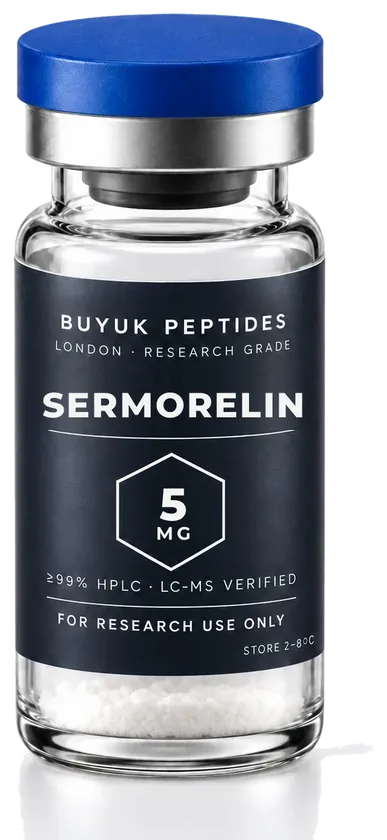
Each vial contains sermorelin as a white lyophilised powder, sealed with a flip-off cap over a crimped stopper, in the net quantity stated on the label: 5 mg. There is no carrier, mannitol or other excipient unless the batch certificate says otherwise. The batch number is printed on the label and matches the certificate in our register.
Reading the certificate for a sermorelin batch
Three results matter. Purity by reversed-phase HPLC is reported as the area of the main peak against all peaks and should be above 98% for a well-made lot. Identity by LC-MS is reported as the observed mass against the expected mass of about 3,358 Da; the modified analogue CJC-1295 (no DAC) is about ten daltons heavier, so a careful reading of this figure distinguishes the two. Net peptide content gives the milligrams of peptide actually in the vial, as distinct from the nominal fill, which is the figure you need when preparing stock solutions.
The impurities to expect in a sermorelin lot are the ones its sequence predicts: a small peak at plus 16 Da from oxidation of the methionine, and a slightly earlier-eluting peak at plus 1 Da from deamidation of the asparagine. Both should be below 1% in a fresh lyophilised batch; a higher figure suggests the material has been poorly stored. Our guide to reading a certificate of analysis walks through annotated examples.
Storage and handling
Sealed vials should be kept refrigerated at 2 to 8 °C and protected from light; for storage beyond a few months, −20 °C is preferable because of the methionine. The lyophilised powder is stable for over a year under those conditions. Allow the vial to reach room temperature before opening so that condensation does not form on the powder, since moisture accelerates both oxidation and deamidation. Sermorelin dissolves readily in water or dilute buffer at neutral pH. Reconstituted solutions should be prepared fresh or aliquoted and frozen; the storage and stability guide covers solvents, concentrations and freeze-thaw behaviour.