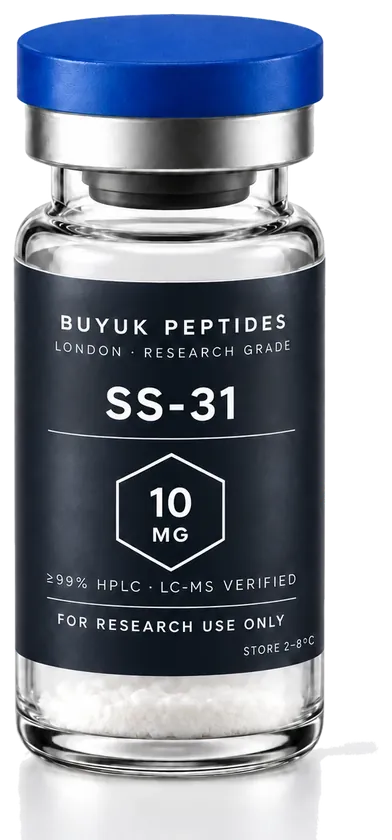
What SS-31 is
SS-31 is a synthetic tetrapeptide with the sequence D-Arg-Dmt-Lys-Phe-NH2, where Dmt is 2',6'-dimethyltyrosine and the C-terminus is amidated. It belongs to the family of Szeto-Schiller peptides designed by Hazel Szeto and Peter Schiller, who were investigating short, aromatic-cationic sequences and found that this one concentrated in mitochondria rather than at the opioid receptors they had originally been studying. The alternating pattern of basic and aromatic residues is what carries the molecule across membranes and into the inner mitochondrial membrane, where it is reported to bind the phospholipid cardiolipin.
The compound was later developed by Stealth BioTherapeutics under the code MTP-131 and is known by the non-proprietary name elamipretide. The D-arginine at the first position and the dimethylated tyrosine make it resistant to aminopeptidases, which is why a sequence of only four residues has a useful lifetime in biological preparations. The average molecular weight is approximately 640 g/mol and the CAS number is 736992-21-5.
The published literature on the compound, with references, is collected in the monograph.
What you receive
Each vial contains SS-31 as a white to off-white lyophilised powder, sealed with a flip-off cap over a crimped stopper, in the net quantity stated on the label: 10 mg or 50 mg. The peptide is supplied as an acetate salt, with no carrier, mannitol or other excipient unless the batch certificate says otherwise. The batch number is printed on the label and matches the certificate in our register.
Reading the certificate for an SS-31 batch
Purity by reversed-phase HPLC is reported as the area of the main peak against all peaks and should be above 99% for a tetrapeptide. Identity by LC-MS is reported as the observed mass against the expected mass of about 640 Da for the protonated molecule. The point to check is that the mass corresponds to the dimethylated tyrosine rather than plain tyrosine, a difference of 28 Da. Net peptide content gives the milligrams of peptide actually in the vial after allowing for water and the acetate counter-ion.
The impurities occasionally seen are the free acid form, where the C-terminal amide has been lost, and traces of residual trifluoroacetate from purification if the salt exchange was incomplete. Our guide to reading a certificate of analysis shows annotated examples, and HPLC and LC-MS explained describes the methods behind the figures.
Storage and handling
Sealed vials should be kept refrigerated at 2 to 8 °C and protected from light; −20 °C is preferable for storage beyond a few months, and the lyophilised powder is stable for well over a year under those conditions. Small cationic peptides supplied as acetate salts are hygroscopic, so allow the vial to reach room temperature before opening and reseal promptly after weighing. SS-31 dissolves readily in water or bacteriostatic water to give a clear, colourless solution. Solutions are reasonably stable refrigerated for short periods but should be aliquoted and frozen for longer work; the storage and stability guide covers solvents, concentrations and freeze-thaw behaviour.