Free Royal Mail Tracked 24 on every order · Same-day dispatch before 3pmIndependent HPLC and LC-MS certificate on every batch
BuyUK PeptidesResearch peptides, London
Home/Catalogue/Peptide fragments/TB-500
Peptide fragments · 7 amino acids · CAS 885340-08-9

TB-500, Thymosin β4 fragment (17–23)

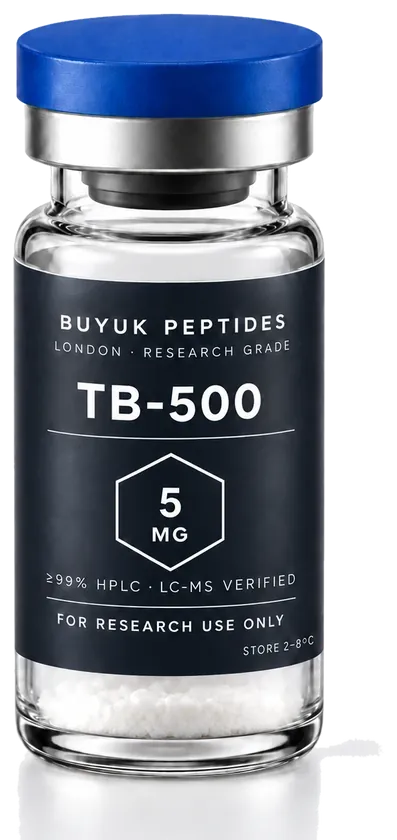
The N-acetylated seven-residue actin-binding fragment of thymosin beta-4 (residues 17 to 23), supplied as a lyophilised research powder in 5 mg and 10 mg vials, with an independent HPLC and LC-MS certificate published for every batch.

Vial size
£19.00BK-TB-5 · Out of stock
Certificate of analysisLot PEPTIDETAI2026118
TB-500 5 mg
Purity, RP-HPLC, 220 nm
99.75 %
Net peptide content
5.6 mg
Tested
19 Feb 2026
Laboratory
Janoshik

About TB-500

Written for laboratory researchers from the published literature. Not medical advice; nothing on this page describes use in humans or animals.

What TB-500 is

TB-500, also written TB500 and often searched as "TB-500 peptide", is the name commonly given to a short synthetic fragment of thymosin beta-4, a 43-residue protein that is abundant in most mammalian cells and is the main intracellular sequestering agent for monomeric actin. The fragment we supply is residues 17 to 23 of that protein, Leu-Lys-Lys-Thr-Glu-Thr-Gln, with an acetyl group on the N-terminus to match the acetylated N-terminus of the parent protein. This heptapeptide contains the LKKTET motif that is responsible for binding actin, and it is the segment most often studied when the question is which part of thymosin beta-4 accounts for a given observation.

The name has also been applied, in the grey market and in some older literature, to the full-length 43-residue protein. The two are very different molecules: the fragment has an average molecular weight of approximately 889 g/mol, while the full protein is close to 4,963 g/mol. We supply the fragment, and the LC-MS result on every certificate makes the distinction unambiguous. The CAS number for the acetylated heptapeptide is 885340-08-9.

The published literature on the compound, with references, is collected in the monograph.

What you receive

Each vial contains TB-500 as a white lyophilised powder, sealed with a flip-off cap over a crimped stopper, in the net quantity stated on the label: 5 mg or 10 mg. There is no carrier, mannitol or other excipient unless the batch certificate says otherwise. The batch number is printed on the label and matches the certificate in our register.

Reading the certificate for a TB-500 batch

Purity by reversed-phase HPLC is reported as the area of the main peak against all peaks and should be above 99% for a heptapeptide. Identity by LC-MS is reported as the observed mass against the expected mass of about 889 Da. This single number answers the most important question about any product sold under this name, since a mass of several thousand daltons would mean the vial contains the full-length protein, and a mass 42 daltons lower than expected would mean the N-acetyl group is missing. Net peptide content gives the milligrams of peptide actually present after allowing for water and counter-ions.

The impurities seen with this fragment are usually deletion sequences and a trace of the deacetylated form, both of which elute close to the main peak. At the sub-1% level these are normal. Our guide to reading a certificate of analysis shows annotated examples, and HPLC and LC-MS explained describes the methods.

Storage and handling

Sealed vials should be kept refrigerated at 2 to 8 °C and protected from light; −20 °C is preferable for storage beyond a few months, and the lyophilised powder is stable for well over a year under those conditions. The heptapeptide is hydrophilic and modestly hygroscopic, so allow the vial to reach room temperature before opening. It dissolves readily in water, saline or bacteriostatic water at neutral pH. Solutions are best prepared fresh or aliquoted and frozen; the storage and stability guide covers solvents, concentrations and aliquoting.

Specification

Reference values pending verification against the batch certificate.

CAS number
885340-08-9
Molecular formula
C38H68N10O14
Molecular weight
889 g/mol
Sequence
Ac-LKKTETQ
Appearance
White to off-white lyophilised powder
Purity
≥99% by RP-HPLC, per batch certificate
Net content
5 mg, 10 mg
Storage, sealed
2–8 °C short term; −20 °C or below long term; protect from light; avoid freeze–thaw cycles
Storage, reconstituted
2–8 °C; use within the period stated in the compound monograph
Research use
In-vitro laboratory research only

Questions about TB-500

Is TB-500 the same thing as thymosin beta-4?

No, and the names are often confused. Thymosin beta-4 is a 43-residue protein. TB-500 as we supply it is the seven-residue fragment Ac-Leu-Lys-Lys-Thr-Glu-Thr-Gln, corresponding to residues 17 to 23 of thymosin beta-4, which is the segment that binds actin. Some suppliers use the name for the full-length protein, so the certificate's LC-MS mass is the reliable way to know which you have.

What does the certificate for a TB-500 batch show?

HPLC purity as area-percent of the main peak, LC-MS identity as the observed mass against the expected mass of about 889 Da for the acetylated heptapeptide, net peptide content per vial, and the laboratory that performed the tests. A mass near 4,963 Da would indicate full-length thymosin beta-4 rather than the fragment.

Why 5 mg and 10 mg vials for such a small peptide?

At about 889 g/mol, 5 mg of TB-500 is a large molar quantity, enough for an extended series of cell-culture or actin-binding assays. The 10 mg size lowers the per-milligram cost for repeated protocols and matches the 10 mg of BPC-157 used in our blends. Both sizes come from batches with their own published certificate.

What does the N-acetyl group do?

The native thymosin beta-4 protein is acetylated at its N-terminus, and the fragment is made the same way. Acetylation removes the free amine at the start of the chain, which reduces susceptibility to aminopeptidases and alters the charge. On the certificate it adds 42 daltons to the expected mass relative to the unacetylated sequence, so its presence is confirmed by LC-MS.

What is in the vial?

TB-500 as a white to off-white lyophilised powder, sealed under nitrogen, in the net quantity stated on the label. No carrier, no excipient unless the certificate says otherwise.

Which batch will I receive?

The batch shown in the certificate panel for the size you choose. Its number is printed on the vial and on your dispatch note, and its full report is on the batch page.

How is purity measured?

By reversed-phase HPLC at an independent laboratory, reported as the area of the main peak against all peaks. Identity is confirmed by LC-MS against the expected mass.

How should the sealed vial be stored?

2–8 °C short term; −20 °C or below long term; protect from light; avoid freeze–thaw cycles

When is my order dispatched?

Same day for orders placed before 3pm, Monday to Saturday, by Royal Mail Tracked 24. Delivery is free.

Who may buy?

Researchers and institutions aged 18 or over, for in-vitro laboratory use under our terms. Nothing we sell is for human or veterinary use.

Chat on WhatsApp