Free Royal Mail Tracked 24 on every order · Same-day dispatch before 3pmIndependent HPLC and LC-MS certificate on every batch
BuyUK PeptidesResearch peptides, London
Home/Catalogue/GHRH, GHS & IGF analogues/Tesamorelin
GHRH, GHS & IGF analogues · 44 amino acids · CAS 218949-48-5

Tesamorelin

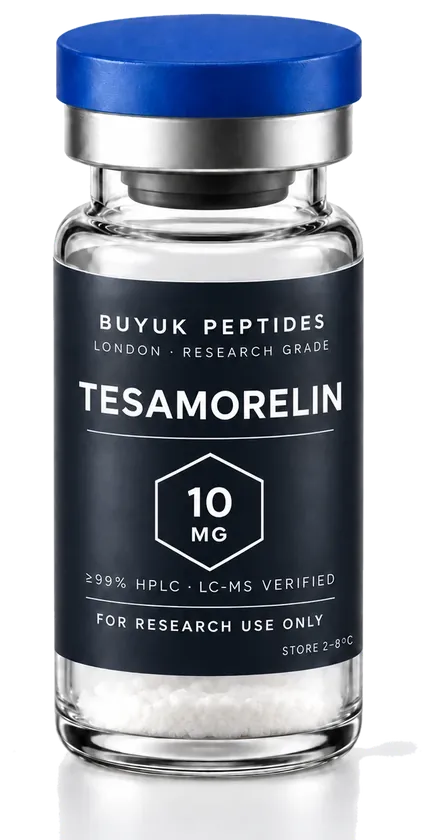
A 44-residue analogue of full-length human growth-hormone-releasing hormone with a trans-3-hexenoyl group on the N-terminal tyrosine, supplied as a lyophilised research powder in 10 mg vials with an independent HPLC and LC-MS certificate for every batch.

Vial size
£63.00BK-TESA-10 · In stock, dispatched today before 3pm
Certificate of analysisLot -EGB-WWB1125-TSM10
Tesamorelin 10 mg
Purity, RP-HPLC, 220 nm
99.03 %
Net peptide content
10.7 mg
Tested
28 Nov 2025
Laboratory
Janoshik

About Tesamorelin

Written for laboratory researchers from the published literature. Not medical advice; nothing on this page describes use in humans or animals.

What tesamorelin is

Tesamorelin is a synthetic analogue of the complete 44-residue human growth-hormone-releasing hormone. Its one modification is a trans-3-hexenoyl group attached to the amino terminus of the first residue, tyrosine. The native hormone is cleaved between tyrosine 1 and alanine 2 by dipeptidyl peptidase-4 within minutes of entering plasma; the hexenoyl group blocks that cleavage without altering the residues that contact the receptor. The C-terminus is amidated, as in the native hormone.

The compound was developed by Theratechnologies in Montreal under the code TH9507 and is the only GHRH analogue of full length in the catalogue, which makes it a useful comparator for the 29-residue fragments sermorelin and CJC-1295 (no DAC). The average molecular weight is approximately 5,136 g/mol and the CAS number is 218949-48-5.

The published literature on the compound, with references, is collected in the monograph.

What you receive

Each vial contains tesamorelin as a white lyophilised powder, sealed with a flip-off cap over a crimped stopper, in the net quantity stated on the label: 10 mg. There is no carrier, mannitol or other excipient unless the batch certificate says otherwise. The batch number is printed on the label and matches the certificate in our register.

The same batch is supplied to every customer while it is shipping, so the figures on the certificate are the figures for your vial. When a batch sells out, the next one is tested and published before the product is listed again.

Reading the certificate for a tesamorelin batch

Three results matter. Purity by reversed-phase HPLC is reported as the area of the main peak against all peaks. For a 44-residue synthetic peptide the realistic ceiling is a little lower than for a short one, and above 98% is a good lot. Identity by LC-MS is reported as the observed mass against the expected mass of about 5,136 Da. A peptide of this size produces several multiply charged ions, and the laboratory deconvolutes them to a single intact mass; a match within instrument tolerance confirms both the full-length sequence and the presence of the hexenoyl group, since the unmodified hormone is about 96 Da lighter. Net peptide content gives the milligrams of peptide actually in the vial, as distinct from the nominal fill.

The impurities to expect are those common to longer syntheses: single-residue deletion sequences eluting just before the main peak, and a small oxidation product from the methionine at position 27. These are normal at the sub-1% level. Our guide to reading a certificate of analysis walks through annotated examples.

Storage and handling

Sealed vials should be kept refrigerated at 2 to 8 °C and protected from light; for storage beyond a few months, −20 °C is preferable. The lyophilised powder is stable for well over a year under those conditions. Allow the vial to reach room temperature before opening so that condensation does not form on the powder. Tesamorelin dissolves readily in water or dilute buffer at neutral pH. Reconstituted solutions should be prepared fresh or aliquoted and frozen; the storage and stability guide covers solvents, concentrations and freeze-thaw behaviour.

Specification

Reference values pending verification against the batch certificate.

CAS number
218949-48-5
Molecular formula
C221H366N72O67S
Molecular weight
5135.9 g/mol
Appearance
White to off-white lyophilised powder
Purity
≥99% by RP-HPLC, per batch certificate
Net content
10 mg
Storage, sealed
2–8 °C short term; −20 °C or below long term; protect from light; avoid freeze–thaw cycles
Storage, reconstituted
2–8 °C; use within the period stated in the compound monograph
Research use
In-vitro laboratory research only

Questions about Tesamorelin

How does tesamorelin differ from sermorelin?

Sermorelin is the first 29 residues of growth-hormone-releasing hormone, unmodified. Tesamorelin is the full 44-residue hormone with a trans-3-hexenoyl group attached to the N-terminal tyrosine. That single modification protects the Tyr-Ala bond from dipeptidyl peptidase-4, which is the main route by which the native hormone is inactivated, and gives tesamorelin a longer plasma half-life in the published pharmacokinetics.

What does the certificate for a tesamorelin batch show?

It reports purity by reversed-phase HPLC as area-percent of the main peak, identity by LC-MS as the observed mass against the expected mass of about 5,136 Da, and the net peptide content per vial. For a 44-residue peptide the mass spectrum shows several charge states, and the laboratory deconvolutes these to a single intact mass. The signed PDF is linked from the batch page.

Why is tesamorelin offered only in 10 mg vials?

At about 5,136 g/mol, 10 mg is roughly two micromoles, which is enough for an extended series of receptor or stability assays while keeping the vial on a single current batch. Longer peptides are more expensive to synthesise at high purity than short ones, so a single well-chosen size keeps the per-vial cost reasonable without leaving large unused quantities in storage.

Is this the same molecule as TH9507 or the licensed product?

It is synthesised to the published sequence and N-terminal modification of tesamorelin, which was developed under the code TH9507, and identity is confirmed on every batch by LC-MS against that structure's expected mass. It is research-grade peptide supplied as an acetate salt for in-vitro work, not a pharmaceutical product, and is not sourced from or endorsed by the originator.

What is in the vial?

Tesamorelin as a white to off-white lyophilised powder, sealed under nitrogen, in the net quantity stated on the label. No carrier, no excipient unless the certificate says otherwise.

Which batch will I receive?

The batch shown in the certificate panel for the size you choose. Its number is printed on the vial and on your dispatch note, and its full report is on the batch page.

How is purity measured?

By reversed-phase HPLC at an independent laboratory, reported as the area of the main peak against all peaks. Identity is confirmed by LC-MS against the expected mass.

How should the sealed vial be stored?

2–8 °C short term; −20 °C or below long term; protect from light; avoid freeze–thaw cycles

When is my order dispatched?

Same day for orders placed before 3pm, Monday to Saturday, by Royal Mail Tracked 24. Delivery is free.

Who may buy?

Researchers and institutions aged 18 or over, for in-vitro laboratory use under our terms. Nothing we sell is for human or veterinary use.

Chat on WhatsApp