Free Royal Mail Tracked 24 on every order · Same-day dispatch before 3pmIndependent HPLC and LC-MS certificate on every batch
BuyUK PeptidesResearch peptides, London
Home/Catalogue/Blends/BPC-157 / TB-500 blend
Blends

BPC-157 / TB-500 blend

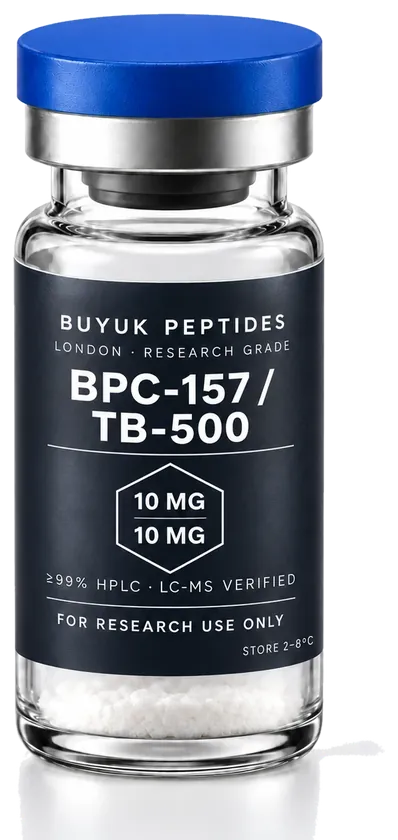
BPC-157 and TB-500 co-lyophilised in a single vial, 10 mg of each, supplied as a research powder with an independent HPLC and LC-MS certificate published for every batch before it is listed.

Vial size
£60.00BK-BPCTB-20 · Out of stock

Certificate for this size is being published and will be linked here before dispatch.

Certificate of analysisAwaiting
BPC-157 / TB-500 blend

No batch of this vial has been released yet. A batch is released only once its independent report is in and published here. Until then it cannot be ordered.

About BPC-157 / TB-500 blend

Written for laboratory researchers from the published literature. Not medical advice; nothing on this page describes use in humans or animals.

What the BPC-157 / TB-500 blend is

This product, usually searched as BPC157 TB500 or the BPC-157 TB-500 blend, is a co-lyophilised preparation of two peptides that laboratories very often order together: BPC-157, the 15-residue fragment of a human gastric protein, and TB-500, the N-acetylated seven-residue fragment of thymosin beta-4 that contains its actin-binding motif. The two are dissolved together in the stated amounts, 10 mg of each, freeze-dried together in a single vial. The resulting powder is a physical mixture at a fixed one-to-one ratio by mass, not a conjugate; the peptides are not covalently linked and behave independently once in solution.

BPC-157 has an average molecular weight of approximately 1,419 g/mol and TB-500 approximately 889 g/mol, so 10 mg of each represents different molar quantities, roughly 7 micromoles of BPC-157 and 11 micromoles of TB-500. Neither component carries a lipid, a disulfide or a metal, and the blend is listed in our blends class alongside the other co-lyophilised vials.

The published literature on the compound, with references, is collected in the monograph.

What you receive

Each vial contains the two peptides as a white lyophilised powder, sealed with a flip-off cap over a crimped stopper, in the net quantities stated on the label: 10 mg of BPC-157 and 10 mg of TB-500, 20 mg of peptide in total. There is no carrier, mannitol or other excipient unless the batch certificate says otherwise. The batch number is printed on the label and matches the certificate in our register. The limitation of a blend is its fixed ratio; a design that needs one component varied while the other is held constant should use the single-compound vials.

Reading the certificate for a blend batch

A blend certificate reads slightly differently from a single-compound one. Identity by LC-MS is confirmed for each component in turn: the laboratory looks for the expected mass of about 1,419 Da for BPC-157 and about 889 Da for TB-500, and both must be present. Purity by reversed-phase HPLC shows two well-separated main peaks rather than one, and the reported purity is the combined area of the two main peaks against all peaks. It should be above 98% for a well-made lot. Net content is reported for the vial as a whole; where the laboratory has quantified each peak against a standard, the per-component figures are given too.

The impurities expected are the same as for the individual peptides, chiefly deletion sequences and a small amount of aspartimide-related product from the Asp-Asp pair in BPC-157. Our guide to reading a certificate of analysis includes a blend example, and HPLC and LC-MS explained describes the methods.

Storage and handling

Sealed vials should be kept refrigerated at 2 to 8 °C and protected from light; −20 °C is preferable for storage beyond a few months. Both components are relatively robust short peptides, and the lyophilised blend is stable for well over a year under those conditions. Allow the vial to reach room temperature before opening to avoid condensation. The powder dissolves readily in water or bacteriostatic water to give a clear solution containing both peptides; solutions should be aliquoted and frozen for anything beyond short-term refrigerated use. The storage and stability guide covers solvents, concentrations and freeze-thaw behaviour.

Specification

Reference values pending verification against the batch certificate.

Components
BPC-157 10 mg · TB-500 10 mg
Appearance
White to off-white lyophilised powder
Purity
≥99% by RP-HPLC, per batch certificate
Net content
10 mg / 10 mg
Storage, sealed
2–8 °C short term; −20 °C or below long term; protect from light; avoid freeze–thaw cycles
Storage, reconstituted
2–8 °C; use within the period stated in the compound monograph
Research use
In-vitro laboratory research only

Questions about BPC-157 / TB-500 blend

What does blend mean on this product?

The two peptides are dissolved together in the stated amounts, 10 mg of BPC-157 and 10 mg of TB-500, and freeze-dried in the same vial, so the powder contains both at a fixed one-to-one ratio by mass. They are not chemically joined; on dissolution the solution contains two separate peptides exactly as it would if you had dissolved one vial of each, with one batch number and one certificate covering the lot.

Why would a laboratory order a blend rather than two vials?

Convenience and traceability. An assay that uses both peptides together needs one vial opened, one reconstitution and one certificate filed rather than two of each, and the two components are guaranteed to come from the same tested lot. The trade-off is that the ratio is fixed, so a design that varies one component independently of the other needs the single-compound vials instead.

What does the certificate for a blend batch show?

The laboratory confirms the identity of each component separately by LC-MS, looking for the expected masses of about 1,419 Da for BPC-157 and 889 Da for TB-500, and reports the combined HPLC purity across both main peaks. Net content is reported for the vial as a whole and, where the laboratory has quantified each peak, per component. The signed PDF is linked from the batch page.

How do BPC-157 and TB-500 differ from one another?

They are unrelated molecules from different proteins. BPC-157 is a 15-residue unmodified sequence derived from a gastric protein; TB-500 is a seven-residue N-acetylated fragment of thymosin beta-4 carrying its actin-binding motif. They are frequently ordered together, but they are unrelated molecules with no shared mechanism in the published work.

What is in the vial?

BPC-157 / TB-500 blend as a white to off-white lyophilised powder, sealed under nitrogen, in the net quantity stated on the label. No carrier, no excipient unless the certificate says otherwise.

Which batch will I receive?

None yet. A size is released for sale only once its batch report is published here.

How is purity measured?

By reversed-phase HPLC at an independent laboratory, reported as the area of the main peak against all peaks. Identity is confirmed by LC-MS against the expected mass.

How should the sealed vial be stored?

2–8 °C short term; −20 °C or below long term; protect from light; avoid freeze–thaw cycles

When is my order dispatched?

Same day for orders placed before 3pm, Monday to Saturday, by Royal Mail Tracked 24. Delivery is free.

Who may buy?

Researchers and institutions aged 18 or over, for in-vitro laboratory use under our terms. Nothing we sell is for human or veterinary use.

Chat on WhatsApp