Free Royal Mail Tracked 24 on every order · Same-day dispatch before 3pmIndependent HPLC and LC-MS certificate on every batch
BuyUK PeptidesResearch peptides, London
Home/Catalogue/Blends/CJC-1295 / Ipamorelin blend
Blends

CJC-1295 / Ipamorelin blend

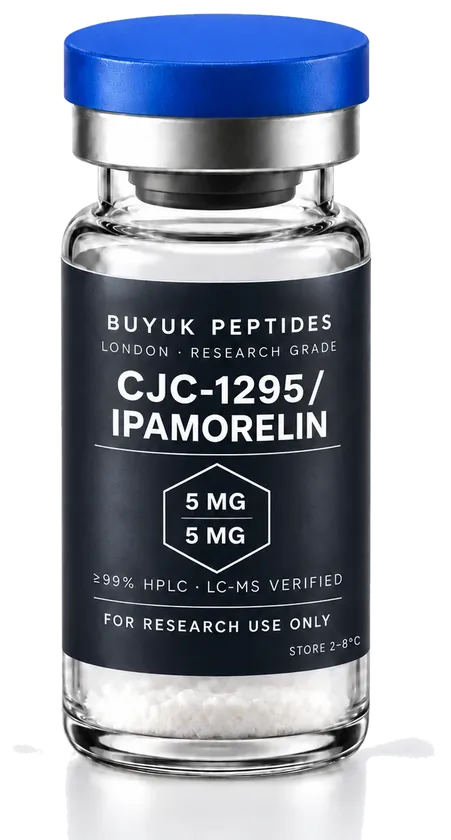
CJC-1295 without DAC and ipamorelin co-lyophilised in a single vial at equal mass, in 5 mg + 5 mg and 10 mg + 10 mg sizes, with an independent HPLC and LC-MS certificate published for every batch.

Vial size
£39.00BK-CJCIPA-10 · Out of stock

Certificate for this size is being published and will be linked here before dispatch.

Certificate of analysisAwaiting
CJC-1295 / Ipamorelin blend

No batch of this vial has been released yet. A batch is released only once its independent report is in and published here. Until then it cannot be ordered.

About CJC-1295 / Ipamorelin blend

Written for laboratory researchers from the published literature. Not medical advice; nothing on this page describes use in humans or animals.

What the CJC-1295 / Ipamorelin blend is

This product, usually searched as CJC 1295 Ipamorelin or CJC1295 Ipamorelin, is a co-lyophilised preparation of two peptides from the growth-hormone-releasing literature that are routinely studied together: CJC-1295 without DAC, the tetrasubstituted analogue of the first 29 residues of growth-hormone-releasing hormone, and ipamorelin, the pentapeptide ghrelin-receptor agonist developed at Novo Nordisk. The two are dissolved together in equal amounts, 5 mg of each or 10 mg of each, freeze-dried together in a single vial. The powder is a physical mixture at a fixed ratio, not a conjugate, and the peptides behave independently once dissolved.

CJC-1295 no DAC has an average molecular weight of approximately 3,368 g/mol and ipamorelin approximately 712 g/mol, so equal masses correspond to roughly five times as many moles of ipamorelin. Neither carries a lipid or a metal. The blend is listed in our blends class.

The published literature on the compound, with references, is collected in the monograph.

What you receive

Each vial contains the two peptides as a white lyophilised powder, sealed with a flip-off cap over a crimped stopper, in the net quantities stated on the label: 5 mg + 5 mg or 10 mg + 10 mg. There is no carrier, mannitol or other excipient unless the batch certificate says otherwise. The batch number is printed on the label and matches the certificate in our register. The limitation of a blend is the fixed ratio; a design that needs the two components varied independently should use the single-compound vials of each.

Reading the certificate for a blend batch

Identity by LC-MS is confirmed for each component separately. The laboratory looks for the expected mass of about 3,368 Da for CJC-1295 no DAC and about 712 Da for ipamorelin. Both must be present, and the CJC-1295 mass in particular must match the no-DAC value; a mass some 150 Da higher would indicate the DAC-linked form. Purity by reversed-phase HPLC shows two well-separated main peaks, and the reported purity is their combined area against all peaks; it should be above 98% for a well-made lot. Net content is reported for the vial as a whole and, where quantified, per component.

The impurities expected are deletion sequences and oxidation of the methionine in CJC-1295, both of which elute near its main peak. Our guide to reading a certificate of analysis includes a blend example, and HPLC and LC-MS explained describes the methods.

Storage and handling

Sealed vials should be kept refrigerated at 2 to 8 °C and protected from light; −20 °C is preferable for storage beyond a few months, and the lyophilised blend is stable for well over a year under those conditions. Allow the vial to reach room temperature before opening to avoid condensation. The powder dissolves readily in water or bacteriostatic water to give a clear solution containing both peptides. CJC-1295 contains a methionine and is the more oxidation-sensitive of the two, so solutions should be aliquoted and frozen rather than kept refrigerated for long; the storage and stability guide covers solvents, concentrations and freeze-thaw behaviour.

Specification

Reference values pending verification against the batch certificate.

Components
CJC-1295 (no DAC) · Ipamorelin
Appearance
White to off-white lyophilised powder
Purity
≥99% by RP-HPLC, per batch certificate
Net content
5 mg / 5 mg, 10 mg / 10 mg
Storage, sealed
2–8 °C short term; −20 °C or below long term; protect from light; avoid freeze–thaw cycles
Storage, reconstituted
2–8 °C; use within the period stated in the compound monograph
Research use
In-vitro laboratory research only

Questions about CJC-1295 / Ipamorelin blend

Which form of CJC-1295 is in the blend?

The version without the drug affinity complex, often written CJC-1295 no DAC or Modified GRF (1–29). It is the tetrasubstituted 29-residue GHRH analogue on its own, without the maleimide linker that the DAC version uses to bind serum albumin. The no-DAC form has a mass of about 3,368 Da, which is the figure the LC-MS result on the certificate is checked against.

What does blend mean on this product?

The two peptides are dissolved together in equal amounts, freeze-dried together in one vial, so the powder contains both at a fixed one-to-one ratio by mass. They are not chemically joined. Because ipamorelin is a much lighter molecule, equal mass means roughly five times as many moles of ipamorelin as of CJC-1295, which matters when calculating concentrations.

Why are a GHRH analogue and a GHS combined in one vial?

CJC-1295 acts at the GHRH receptor and ipamorelin at the ghrelin receptor, two distinct receptors on the same pituitary cell type, and the published in-vitro literature on this receptor pair has examined them together in cultured pituitary cells. A laboratory running such a design needs one vial, one reconstitution and one certificate rather than two, with both components from the same tested lot.

What does the certificate for this blend show?

The laboratory confirms each component's identity separately by LC-MS, looking for about 3,368 Da for CJC-1295 no DAC and about 712 Da for ipamorelin, and reports the combined HPLC purity across both main peaks, which elute well apart. Net content is reported for the vial as a whole and, where quantified, per component. The signed PDF is linked from the batch page.

What is in the vial?

CJC-1295 / Ipamorelin blend as a white to off-white lyophilised powder, sealed under nitrogen, in the net quantity stated on the label. No carrier, no excipient unless the certificate says otherwise.

Which batch will I receive?

None yet. A size is released for sale only once its batch report is published here.

How is purity measured?

By reversed-phase HPLC at an independent laboratory, reported as the area of the main peak against all peaks. Identity is confirmed by LC-MS against the expected mass.

How should the sealed vial be stored?

2–8 °C short term; −20 °C or below long term; protect from light; avoid freeze–thaw cycles

When is my order dispatched?

Same day for orders placed before 3pm, Monday to Saturday, by Royal Mail Tracked 24. Delivery is free.

Who may buy?

Researchers and institutions aged 18 or over, for in-vitro laboratory use under our terms. Nothing we sell is for human or veterinary use.

Chat on WhatsApp