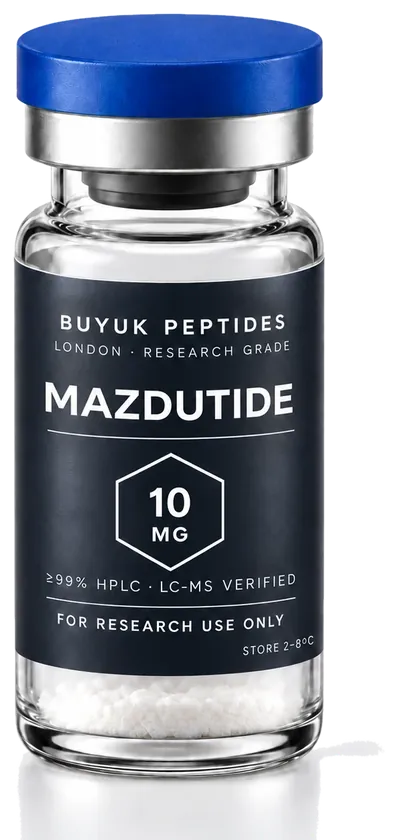
What mazdutide is
Mazdutide is a synthetic lipidated analogue of oxyntomodulin, a hormone released from the gut that activates both the glucagon-like peptide-1 receptor (GLP-1R) and the glucagon receptor (GCGR). It was originally developed at Eli Lilly under the code LY3305677 and licensed to Innovent Biologics for China, where it is known as IBI362. Like survodutide it belongs to the glucagon/GLP-1 pairing of dual agonists, as distinct from the GIP/GLP-1 pairing of tirzepatide.
The native oxyntomodulin sequence is rapidly cleared and degraded by DPP-4, so mazdutide incorporates stabilising substitutions near the N-terminus and a fatty-acid side-chain attached to a lysine residue through a linker. The side-chain binds reversibly to serum albumin and extends the half-life to several days in the published pharmacokinetics. We do not quote a CAS registry number for mazdutide because we have not verified one; identity is established by sequence and by LC-MS on every batch.
The published literature on the compound, with references, is collected in the monograph.
What you receive
Each vial contains mazdutide as a white to off-white lyophilised powder, sealed with a flip-off cap over a crimped stopper, in the net quantity stated on the label: 10 mg. There is no carrier, mannitol or other excipient unless the batch certificate says otherwise. The batch number is printed on the label and matches the certificate in our register.
Reading the certificate for a mazdutide batch
Purity by reversed-phase HPLC is reported as the area of the main peak against all peaks and should be above 98% for a lipidated peptide, with the best lots above 99%. Identity by LC-MS is reported as the observed mass against the expected mass for the full lipidated sequence. The lipid and linker contribute several hundred daltons, so a batch in which the modification is missing or truncated fails this check clearly. Net peptide content gives the milligrams of peptide actually present, after allowing for the water and counter-ions that lyophilised powders retain.
Oxyntomodulin-based sequences, like glucagon, contain methionine and tryptophan, so oxidised variants are the impurities to look for along with the usual deletion sequences. These elute close to the main peak and are normal at the sub-1% level. Our guide to reading a certificate of analysis shows annotated examples, and HPLC and LC-MS explained describes the methods.
Storage and handling
Sealed vials should be kept refrigerated at 2 to 8 °C and protected from light; −20 °C is preferable for storage beyond a few months, and the lyophilised powder is stable for well over a year under those conditions. The lipidated chain is hygroscopic, so allow the vial to reach room temperature before opening. Peptides of the glucagon family are least soluble near neutral pH, so for in-vitro work a mildly acidic solvent such as acetic acid 0.6% is often the easier starting point, followed by dilution into the assay buffer. Solutions should be prepared fresh or aliquoted and frozen; the storage and stability guide covers solvents, concentrations and freeze-thaw behaviour.